
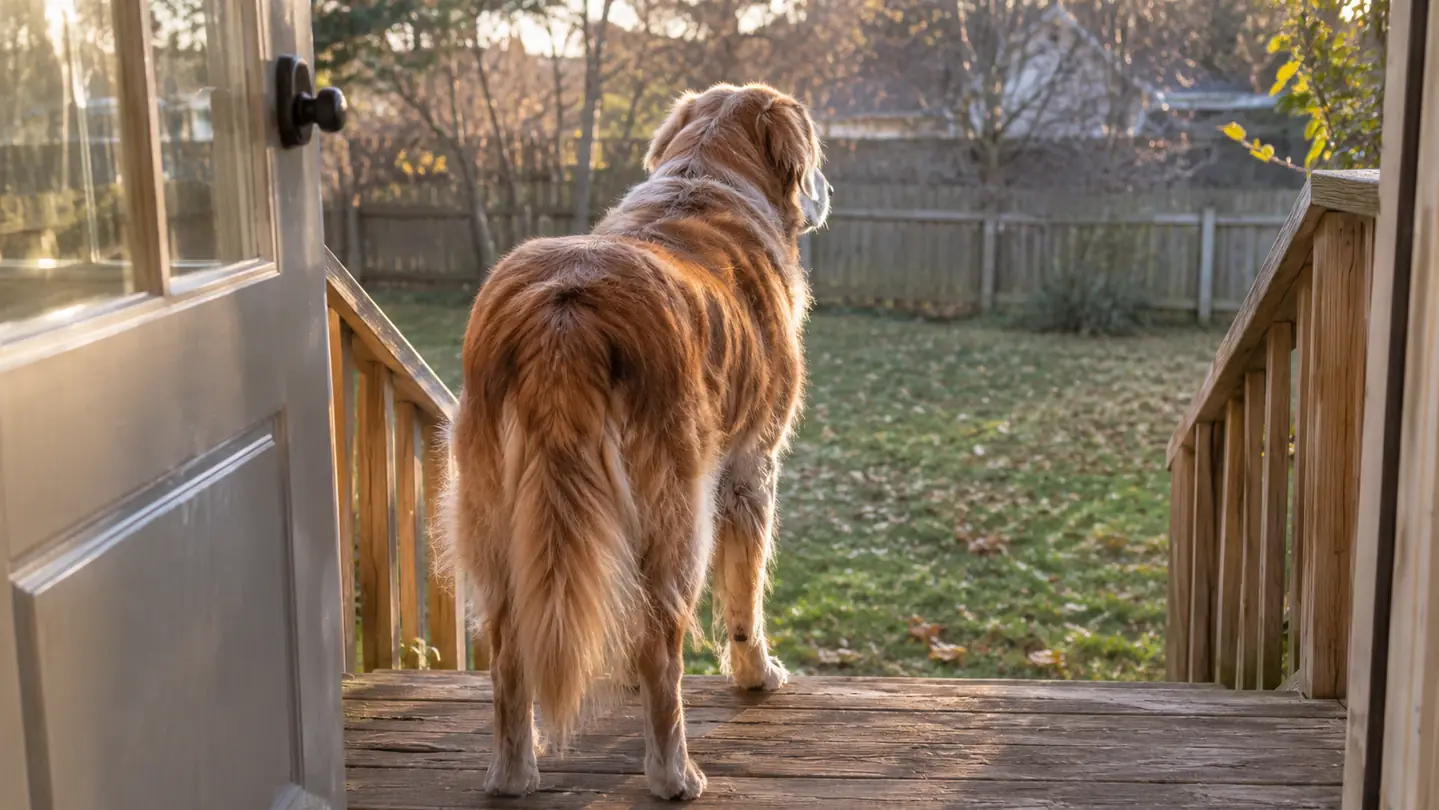
Maple is twelve, seventy-four pounds, and until this year she took the three wooden steps off my back door at a trot. In February my vet found arthritis in both hips and the left elbow. The steps did not get taller. She just started stopping at the top of them, front paws on the sill, back end gathered under her, deciding whether the trip was worth it. Some mornings it was not. A seventy-four pound dog who will not go down three steps is a problem with no quiet solution.
If you are reading this, the same pause is probably happening at your house. There is a version of these steps at every back door. I am not a veterinarian and I will not pretend to be one. I am a retired home health nurse, thirty years of moving people who could not move themselves, and the body mechanics of shifting a heavy, unsteady body from one level to another are the same with two legs or four. What follows is the routine I worked out after I bought a LOOBANI lift sling in June. It is not a cure. It is a way to put a handle on the back half of a big dog.
Give Her Back End a Handle Before She Stops Asking to Go Out
A padded sling under the belly, handles over the back, so you take the weight off her hips for the three steps she still wants to take. Just under fifteen ounces, machine washable, and it folds into its own bag.
Amazon Check Today's Price on Amazon →Step 1: Fit It Standing Still, Not on the Stairs
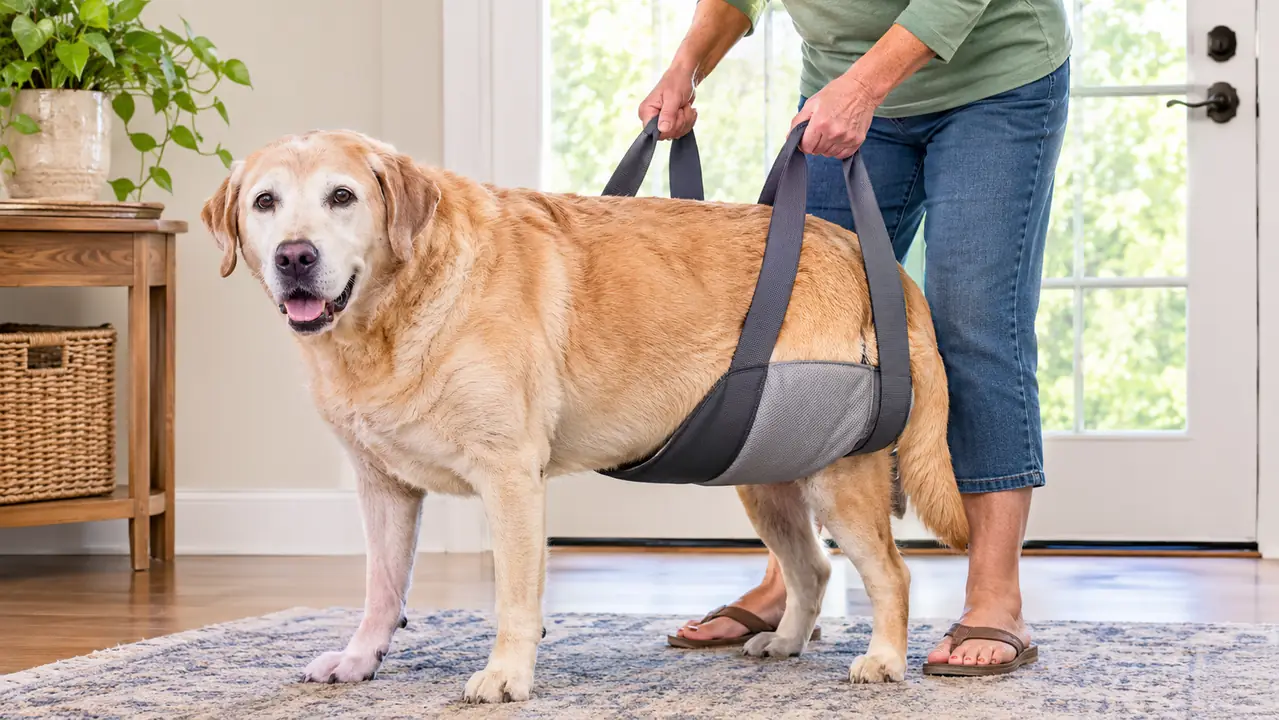
The sling goes under the belly, not around the chest. The padded part passes under her just in front of the hind legs, and the handles come up over her back so they land at the height of your hand when you are standing beside her. Ride it forward onto the ribs and you are lifting her whole body, which she will resent and your shoulders will not enjoy. Let it slide back onto the hips and you have no leverage at all. The first fitting took me three tries and a kitchen chair to sit on while I worked it out.
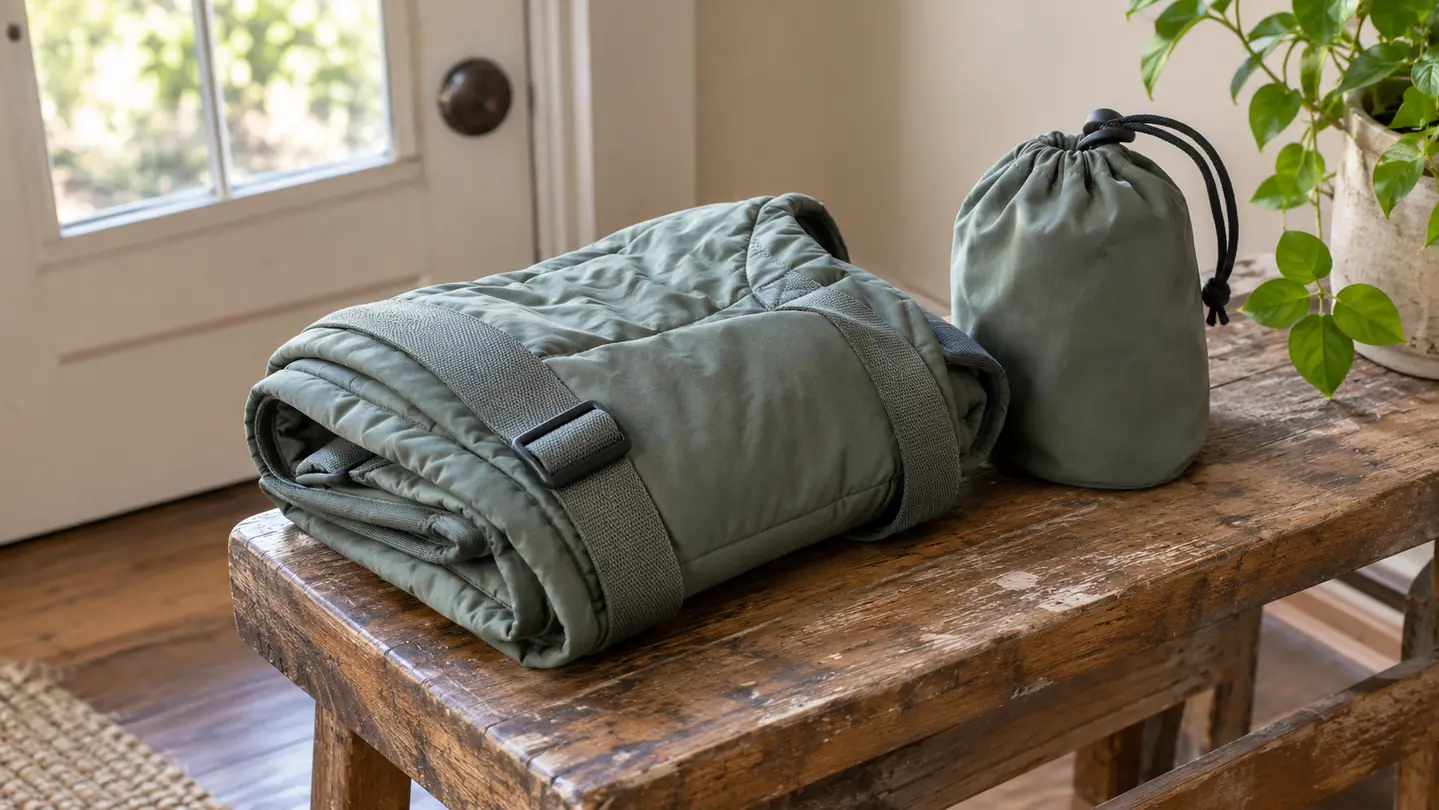
Maple takes the X-Large at seventy-four pounds. The LOOBANI sling weighs just under fifteen ounces, which sounds like a small thing until you have fumbled with a strap in the dark at six in the morning. It folds flat into the storage bag that comes with it, and the nylon is machine washable, which matters once it has spent a July under a dog.
Our back steps are three risers of about seven inches each, and there is no railing on the yard side. I measured them with a tape in June because I wanted to know what I was actually asking of her: twenty-one inches down and twenty-one inches back up, twice a day, which works out to close to six hundred inches of steps in a week of fair weather. That number is what convinced me to stop pretending she could manage it on her own.
Do the first fitting in the kitchen, with no stairs involved. Stand her square, slide the padding into place, take up the slack, and let go. She should stand the way she stands without it. If she hunches, it is too far forward. If she steps away from it, it is too loose. I recheck the fit every few weeks, because a dog losing muscle in the hindquarters changes shape faster than you expect.
Step 2: Put It On While She Is Still Lying Down
A sore dog who is already standing is not going to stand still while you work a sling under her. So do it before she gets up. Fold the sling in half the long way, kneel beside her, and slide the fold under the belly from the side she is lying toward. Then bring the ends up and take the handles. By the time she pushes up, the support is already in place and she rises into it.
The first week, Maple lay back down the moment she felt it. So I started leaving it folded on the floor beside her bed and putting it on the second she lifted her head, before she had a chance to think about it. Two mornings of that and she stopped arguing. Now she waits for it, which I did not expect, and I take that as the closest thing to approval a twelve year old Labrador gives.
If your dog snaps or yelps when you touch the rear end, stop. That is a pain question for your vet, not a fitting question, and no sling fixes it. The same goes for a dog who is suddenly worse this week than last. Call first, lift second.
Step 3: Lift With Your Legs and Stand in the Right Place
I am sixty-five and I have a nurse's back, which is to say it has opinions. You are not carrying the dog. You are taking some of the load off her rear so her hind legs can do their own work. That means a short lift, close to your body, knees bent, back straight, and no twisting around to see where she is headed. If you find yourself leaning back with your arms straight out, you are carrying her, and you will not keep that up for long. The morning I tried to hurry her with one hand, she pulled left and I felt the strain across my lower back before I felt anything else. I hung the sling back on the hook, sat down on the top step, and started over. Two hands, her pace, no exceptions since.
Stand beside her, not behind her. Going up the steps, be slightly behind her rear, so the handles sit in front of your hips and you can take weight without pulling her off balance. Going down, be slightly ahead of her, on the step below, so you are steadying the back end as it comes toward you. Same grip, different place.
Both hands on the handles if you can manage it. One hand and a wall if you cannot. What you do not want is one hand on the sling and one on the railing while the dog makes up her mind. Pick the hand for the side away from the open edge and keep it there every single time.
Step 4: Take the Stairs One Step at a Time, and Treat Down Differently
Three back steps turn out to be a long string of small decisions for a dog with sore hips. Front paw, front paw, back paw, back paw, and on the way down the rear end has to be trusted to catch what the eyes can no longer judge clearly. Going up was never Maple's problem. Going down was. She would stand at the top, look at the yard, then look at me.
The sling changed that, but only because I stopped rushing her. One step at a time, in her rhythm, with the sling carrying some of the rear weight and no tugging from me. If she stops halfway, we stop. Counting the steps out loud sounds foolish and it works: she moves on the third number, every time, because she has learned the count ends with a treat at the bottom.
Wet weather is its own problem. The bottom step gets slick from the yard, and the hall floor inside is oak with nothing on it, so a dog who comes in damp and hurried has two chances to slide. I keep a folded towel by the door now. She waits on the mat while I dry her feet, and then she walks back to the kitchen on her own. It adds ninety seconds to every trip out and it has bought me five months without a second fall.
Do not practice on stairs she does not need. Since the ramp arrived it handles most of the back steps, and the LOOBANI sling comes out on her stiff days. A sling used twice a day for five months does not wear out. A dog pushed up and down steps to build strength wears out.
Step 5: Give the Whole Thing an Order and Stick to It
The routine matters as much as the sling. Mine hangs on a hook by the back door, folded, handles up. Down the steps, sling off, sling on the hook. Back up the steps, sling on, sling off, hook. In five months the only time I forgot it was a morning I was in a hurry, and Maple stood at the bottom of the steps waiting for me to catch up.
Wash it more often than you think. It sits under a belly, on a dog who is lying on the floor more than she used to, and it will pick up a smell. The care instructions say machine wash, and I have run it through with the towels and hung it on the line. Saturday morning works for us, because that is when she is asleep in the sun anyway.
And check the weight. If she has lost or gained more than a few pounds, the fit changes even though the sling does not. I put Maple on the vet's scale in August and she was down two pounds, and the sling needed tightening. We weigh her every other month now, a habit I started in June and wish I had started in February. That is the whole routine. There is nothing clever about it, which is the point.
What Else Helps
The sling is one piece of a week, not the whole week. Maple takes her Cosequin chewable tablet each morning with breakfast, on Dr. Amari's suggestion, and it is the only joint supplement she has ever had. She sleeps on a bolstered bed on the carpet on my side of the room, which replaced a thin department store bed that went to the curb in April. She wears traction socks on the oak hallway because of one bad morning when her back legs went out from under her on a floor that suddenly had no grip. She was not hurt, and I did not want to see it twice.
Since August, the ramp by the back door handles most of the steps. It is ten pounds, sixty-two inches long and sixteen wide, rated to one hundred and fifty pounds, and it folds up and stands against the wall inside the door. It took Maple about two weeks of treats to walk it without hesitating. The LOOBANI sling still lives on the hook, because a ramp does not help her cross a wet deck or get off the floor after a long nap, and those are the days it earns its place.
It still goes in the car. Before the ramp, my husband and I lifted her into the Outback between the two of us, which was two people doing a job one person with a sling can do. That is the honest order of how these things got bought. The supplement came first, then the bed, then the socks, then the sling, then the ramp, all of it from Amazon and all of it bought by me, not sent to me to write about.
What the sling does not do is treat arthritis. It does not reduce pain, it does not rebuild muscle, and it will not make a dog who is dragging a hind foot walk normally again. If your dog is knuckling over, scuffing a back paw, or refusing to rise at all, that is a vet visit before it is a purchase. I say that carefully, because I nearly bought my way around a diagnosis in February, and the diagnosis was the only thing that actually helped.
The sling did not make her younger. It made three steps at my back door a thing she could still do herself, which turns out to be most of it.
Three Steps Should Not Be the End of the Yard
Machine washable, just under fifteen ounces, and it goes back on the hook by the door. Fit it in the kitchen first, then let her take the steps at her own pace.
Amazon Check Today's Price on Amazon →