
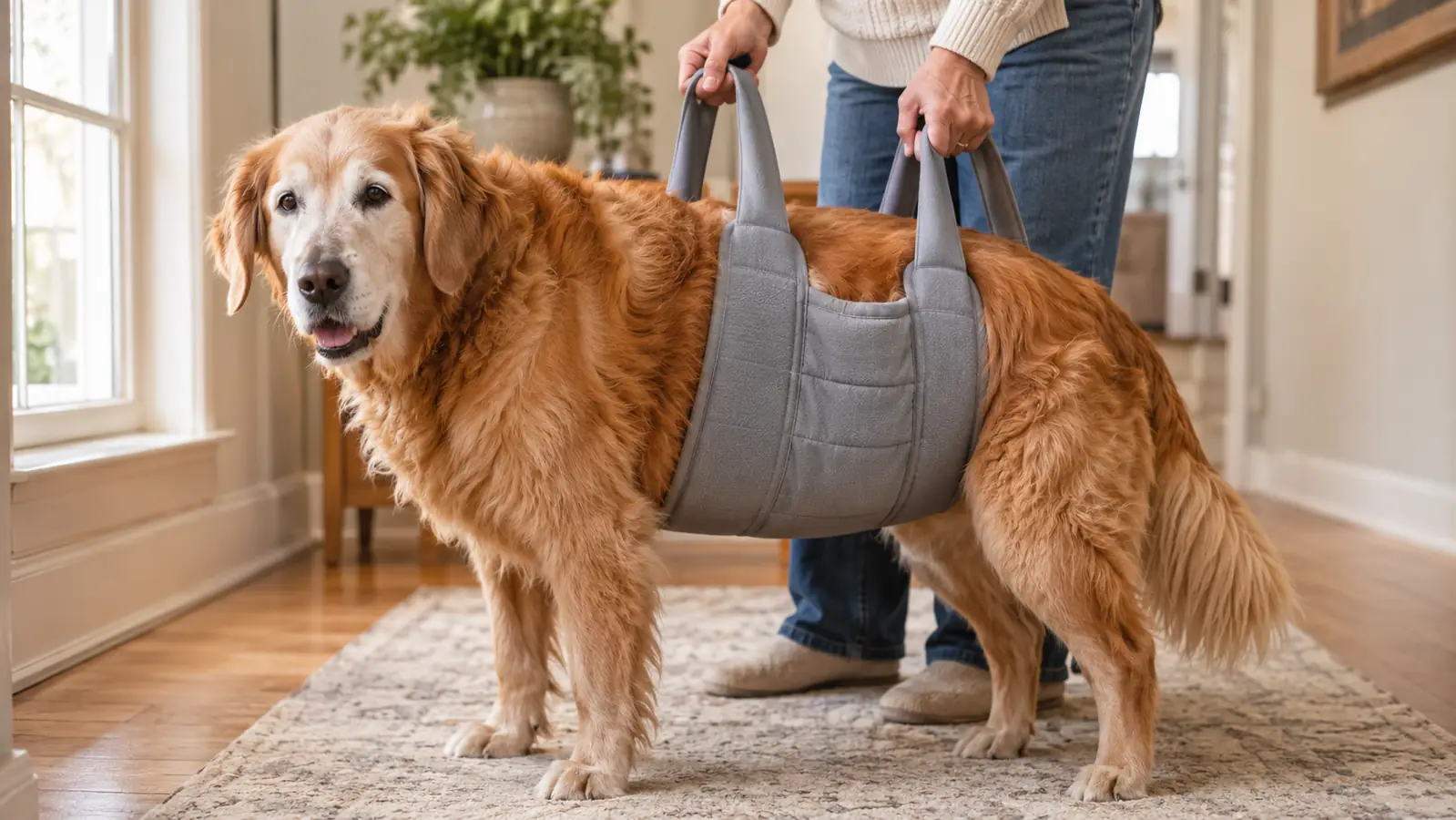
Maple's back legs started folding on her in the spring. She is a 12 year old spayed yellow Labrador mix, 74 pounds, and her vet found arthritis in both hips and the left elbow in February. What that looks like in a hallway is not dramatic. She stands, takes two steps, and the rear end sinks toward the oak floor. I am 65 and I cannot scoop 74 pounds up off the floor with my arms alone, and I should not be trying.
So the second week of June I bought a LOOBANI lift harness. It is a padded nylon sling that goes under the belly with handles along the top, plus a small storage bag, and it is built for the rear end only. It is not a full body harness and it does not pretend to be one. It is the fourth thing I bought for that dog, after the joint chews, the bed and the traction socks, and before the ramp.
Here is the short answer before the long one. For lifting a heavy dog's back end four or five times a day, the LOOBANI is the one hanging in my closet and the one I would buy again. For a dog who needs support that stays put through an entire walk, the PetSafe CareLift is built for a job the sling was never designed to do. Same problem, two different tools, and knowing which job you actually have is most of the decision.
One thing to get out of the way. I have never bought the PetSafe CareLift and I have never had my hands on one. What I know about it comes from its listing and from 31 years of lifting people as a home health nurse, which teaches you where the weight actually goes. I am not comparing two harnesses I have owned. I am comparing the thing that lives in my closet against the one I read about carefully before I spent anything.
Side by Side
| LOOBANI Lift Harness | PetSafe CareLift | |
|---|---|---|
| Type of support | Padded sling that passes under the belly and lifts from underneath | Harness that fastens around the hindquarters and lifts from there |
| Getting it on a dog who is already down | Slide it under the belly from the side, gather the handles, lift | Both hind legs go into it before it fastens over the back |
| Staying put on a longer walk | Can shift and needs re-centering, sometimes twice in one trip down the hall | Stays where you fastened it |
| Dogs touchy about their hind legs | Nothing touches the back legs at all | Straps sit against the hind legs |
| Leaving it on through the day | Made for the lift, then off again | Designed to stay on the body |
| Cleaning | Machine wash per the listing, and it has come out the same both times | The listing does not describe it as machine washable |
| Storage | Folds into the storage bag that comes in the package | Rolls up, no bag described |
| Best for | Lifting a heavy dog up off the floor, into the car, up a step or two | Steadying a dog who needs support for a stretch of time |
Where the LOOBANI Wins
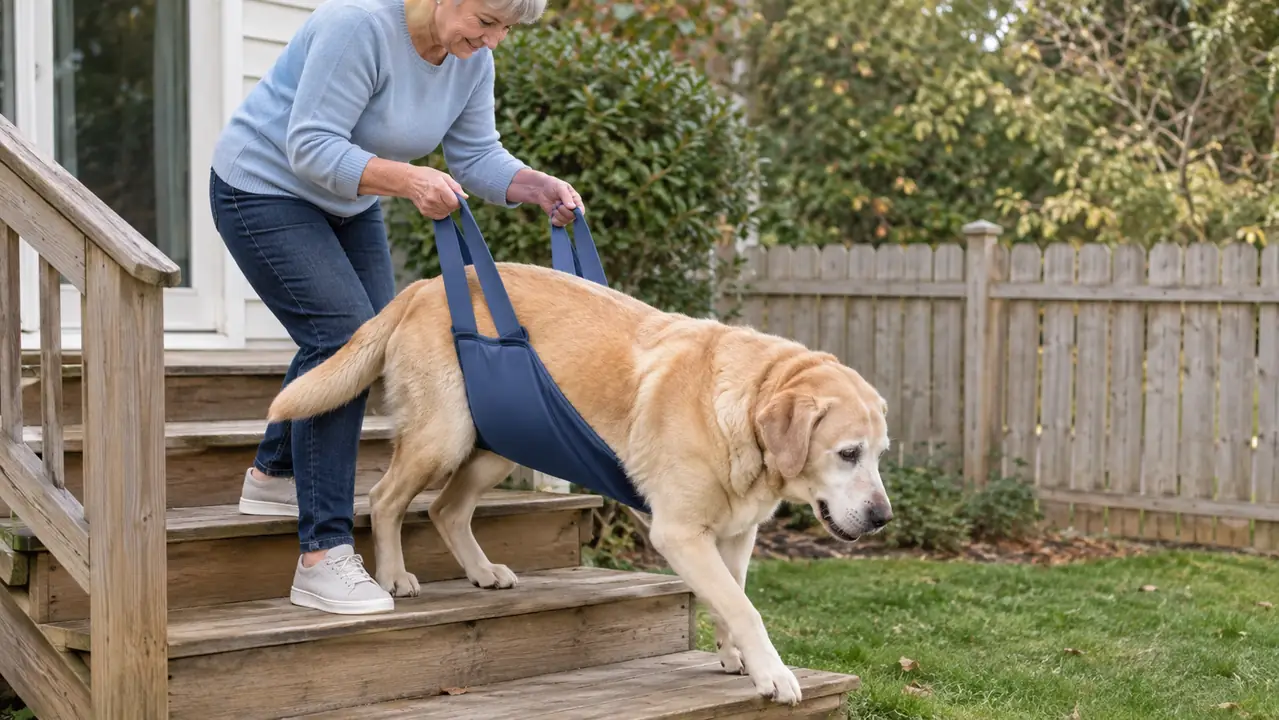
The first place it wins is the moment you actually need it, which is usually the worst moment. If Maple is already down on the floor with her legs splayed, I do not have to talk her into standing up first. I work the sling under her belly from the side, gather the handles, and lift. There is no leg to thread into anything, no strap to find underneath a dog who is lying on it, and no buckle to work by feel while she is anxious. For the first four days, before it arrived, I used a rolled bath towel. The sling is better for one plain reason: my hands fit around it. The first morning I used it, she had gone down flat in the hall outside the bathroom door, half on the oak and half on the carpet runner, with no room to get behind her. I knelt at her side, worked the sling under her belly from the left, and had her standing in maybe fifteen seconds. With the towel I would still have been down there at two minutes, and she would have been struggling the whole time.
The second place is that nothing touches her hind legs. Maple has gotten particular about her back feet, which is common in a dog with sore hips, and she will pull a foot away if you reach for it. A sling under the belly asks nothing of her back legs whatsoever. If your dog snaps or pulls away when you handle the rear end, that single difference is worth more than every feature on a spec sheet, and it is the main reason I stopped looking after I found it.
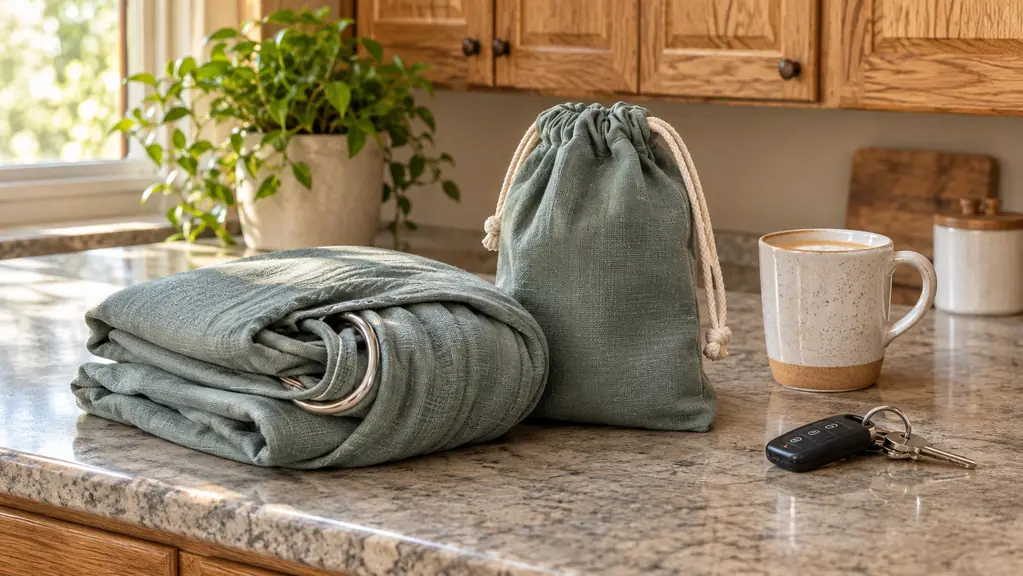
The third is upkeep and size. My listing says machine wash, and it has gone through the wash twice and come out the same. It weighs just under a pound, so it goes in the car for vet visits without my thinking about it, and it folds into the little drawstring bag it came with. It lives on a hook by the back door next to the ramp, and it is the first thing I grab on a stiff morning.
Where the PetSafe CareLift Wins
I will not pretend the harness has nothing on the sling. The CareLift fastens around the hindquarters and stays where you put it. A sling under the belly is a moving thing. On the way down the hall, Maple's own gait walks it forward or sideways, and I stop and re-center it, sometimes twice in one trip. On the oak floor I have learned to slow her down, because a sling that shifts while the dog is moving is a sling that is not fully carrying the weight. If she sets a fast pace toward the door because she can hear Walt in the yard, the sling loses that argument every time.
And the harness is built to stay on. If your dog needs help through an entire walk, or needs steadying for ten minutes in the yard rather than a lift up three steps, something fastened to the body is the better shape for that job. The sling is a lift, and I take it off when the lift is done. That is the honest line between the two, and it is a real one, not a marketing distinction.
The sling I reach for on Maple's stiff mornings
Padded nylon sling under the belly, handles along the top, machine washable, and it folds into its own storage bag for the car. Check today's price and the size chart on the LOOBANI listing before you order.
Amazon Check Today's Price on Amazon →What Lifting 74 Pounds Five Times a Day Actually Feels Like
Nobody warns you that the lifting is the part that wears you down. Maple needs a hand getting up in the morning, on the three wooden steps down to the yard, coming back in, and again before bed. That is four or five lifts a day of a dog heavier than any bag of mulch I have carried out of the garage. By June my lower back had opinions about it.
The sling turns a scoop into a straight pull. I stand beside her, bend at the knees, and lift with both hands close to my hips, the way I was taught to move a patient. My back noticed the difference within about a week. With the towel, the fabric bunched and my grip gave out halfway up, which is the exact moment you do not want a grip to give out. The padded panel spreads the pressure instead of digging in, and Maple does not flinch when I set it under her. I keep the handles gathered in one fist rather than one in each hand. Two hands spread apart made her sway, and a swaying dog on a hardwood floor is a dog about to slip. It took me three or four tries to work that out, and it is not written anywhere on the package. The lifting itself is short, ten seconds up the steps, maybe fifteen off the floor. What wears on a person is not the length of a lift, it is the number of them before noon.
Then the ramp arrived in August and changed the routine more than I expected. The three back steps are the ramp's job now, and the sling comes out only on her stiff days, or for the Outback when the ramp is not set up. I had assumed I would use both every day. I do not, and that is a good thing, because it means fewer lifts on my back and fewer moments where she has to be handled when she would rather not be.
How I'm Judging a Harness I Have Not Bought
Two things I can speak to directly: the sling in my closet, and what a rear lift does to a person's back. Everything else I take from the listings. I read the CareLift description and photos the way I used to read a patient's chart, looking for what the product asks of the dog and what it asks of me. And I will tell you plainly that a photograph cannot tell me how a strap feels against a sore hip. Nobody can tell you that except your own dog.
What I did do was read the middling reviews on the CareLift listing, the three star ones first, because that is where people say the useful thing instead of the happy thing. I did the same with my own sling before it arrived, and I have done it with every dog purchase since 2014. A complaint that shows up once is a bad day. A complaint that shows up eleven times is a fact about the product, and it is the only part of a review page I trust.
The other thing I know from nursing is that a device is only as good as the person's willingness to wear it. Maple tolerated the sling on the first try, which surprised me. A dog who fights anything around the hindquarters will fight a harness longer than she will fight a sling, and you should weigh that against everything the harness does better. If you are choosing between these and can only try one, buy somewhere you can return it. That advice is worth more than the rest of this page.
The sling asks nothing of her back legs. On a dog with sore hips, that is most of the argument right there.
Where Both Fall Short
Neither one is a fix. Maple still has arthritis in both hips and the left elbow, and a sling or a harness carries weight, it does not treat anything. I asked Dr. Amari in June whether a sling could do Maple any harm. Her answer was that it would not, so long as Maple was still doing some of the work herself and I was not hauling her around the house like luggage. That has stayed with me. There is a real difference between helping a dog stand and doing the standing for her, and the sling sits on the right side of that line.
Neither one helps the front end either. The LOOBANI is rear support by design, and the CareLift, as I read the listing, is rear support as well. A dog who is weak in the shoulders needs a different conversation. And neither one solved my back steps. The ramp did that. What the sling does is cover the days in between, the ordinary mornings when she needs a hand and nothing more.
Who Should Buy Which
Buy the LOOBANI if your dog is heavy, already down when you need to move her, touchy about her hind legs, or if you are the one doing the lifting and you need something you can get under a dog in two seconds with one hand while the other hand steadies her. Buy it if the job is a lift: up off the floor, into the car, up a step or two, and then off again. That is my situation most mornings, and it is why this one stays by my door.
Look hard at the PetSafe CareLift instead if your dog needs support that stays put for the length of a walk, if she will wear something around her hindquarters without a fight, and if your problem is steadiness rather than a lift. If you are not sure which camp you are in, start with the sling. It is the simpler tool and it asks less of the dog. In my house, with one dog, a sling under the belly met far less resistance than anything that went around her legs.
For the days she needs a hand, this is the one by my back door
A padded belly sling with handles, machine washable, folds into its own bag, sized for large dogs. Check the listing's size chart before you order, and keep your receipt either way.
Amazon See the LOOBANI Lift Harness on Amazon →