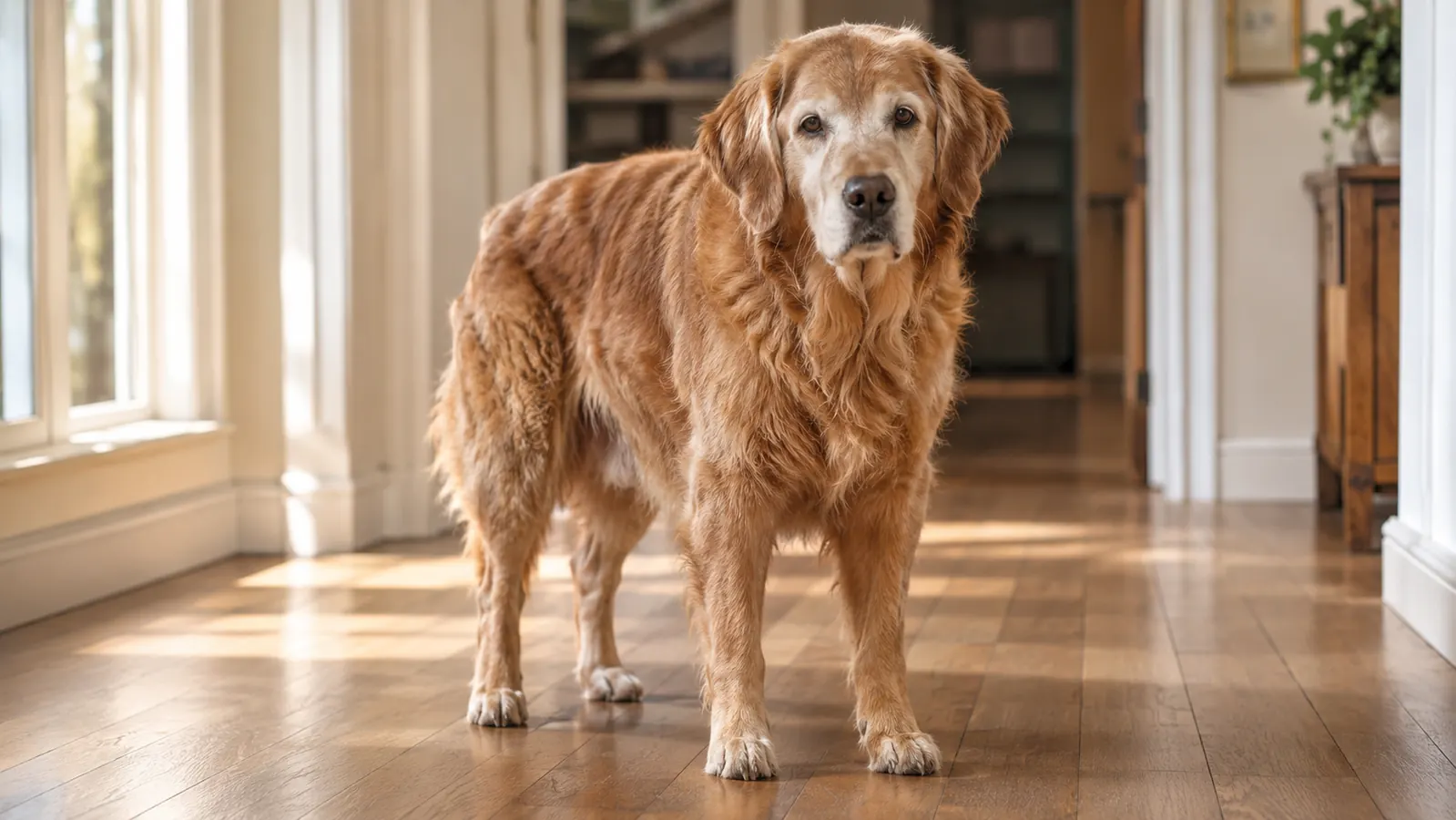
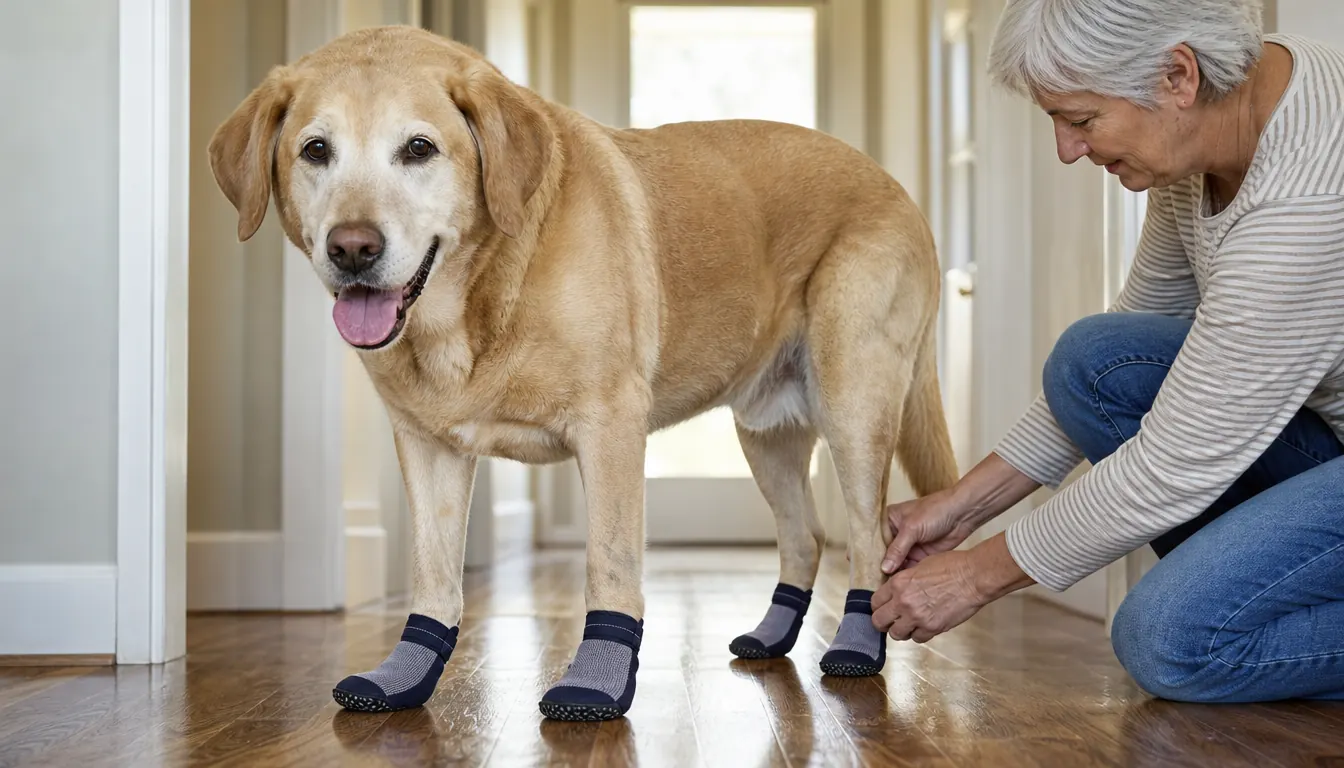
The morning Maple's back legs slid out from under her, she was halfway down the oak hall on her way to the kitchen, right where the boards go slick when the weather turns humid. She is a twelve year old yellow Labrador mix, seventy four pounds, and her vet diagnosed arthritis in both hips and the left elbow in February. She splayed, scrabbled, and got herself up before I got to her. She was not hurt. I sat down on that hall floor anyway with my heart going, because I knew the next one might not end so well. In the first week of May I ordered a four pack of DOK TigerToes non slip dog socks in size Large, after measuring her paw at close to two and three quarter inches against the listing chart. She has worn them indoors during the day for six months now, and they come off at bedtime.
So here is the short answer for anyone standing where I was standing. If your dog will wear something on the foot and you need the whole paw covered, the DOK socks are the simpler fix. If your dog will not keep anything on the foot, or fights you over the ankle, stick-on toe grips are worth a look. I have to be straight with you about what I know. I have used the socks on Maple every day since May. I have never bought the toe grips, never tried them on her, never tried them on any dog. Everything I say about them comes from reading their listings and from years of watching dogs in other people's homes, not from my own floor. That is a real limit, and you should weigh it.
| DOK TigerToes Dog Socks | Stick-On Toe Grips | |
|---|---|---|
| What it covers | The whole paw, pads and the spaces between the toes | The nail only, the pad and top of the paw stay open |
| Fit | You measure the paw. Large is listed for 2.5 to 2.8 inches | Trimmed to each nail, less dependent on a paw measurement |
| Grip if it shifts | Grip is built to hold even when the sock twists | No twisting possible, it is fixed to the nail |
| Putting them on | Four socks, pull on with a hook and loop strap | One nail at a time, with adhesive and time to set |
| A dog who licks a sore paw | Covers the paw, so the licking stops | Does nothing for licking |
| Skin and ankle sensitivity | Something sits around the ankle, and some dogs will not have it | Nothing around the ankle or wrist at all |
| Upkeep | Machine wash, back on the same afternoon | Reapplied on a schedule as the adhesive wears |
| Wet or rough ground outdoors | Indoors on hard floors, not made for wet ground | Concrete and grit wear the nail cap down faster |
| Best for | A big dog on hardwood who needs the whole pad covered | A dog who fights anything on the foot but will sit for nail work |
Two Different Ideas About Traction
A sock and a stick-on grip solve the same problem from opposite ends. The sock says, put a non slip surface on the entire bottom of the paw and hold it there with a strap. The grip says, cap the nail, which is the part of the foot that lands first, and let the pads do the rest. On a dog with good pads and a supple foot, a nail cap can be enough. On a dog whose hips have changed how she places a foot, the whole pad is what is landing, and covering only the front of it leaves most of the contact area bare. That is the mechanical difference, and it is the one that decided it for us.
There is a second difference that took me a while to see, and it is about the owner more than the dog. Socks are a routine. They go on after breakfast and come off at bedtime, like slippers, and the washing machine handles the maintenance. Grips are a task, done on a schedule, nail by nail, with the dog's cooperation. Some people are built for routine and some are built for tasks. I am built for routine. That is not a virtue, it is just what I know I will actually keep up with, and the thing you keep up with beats the thing that is theoretically better.
What Maple's Floors Actually Needed
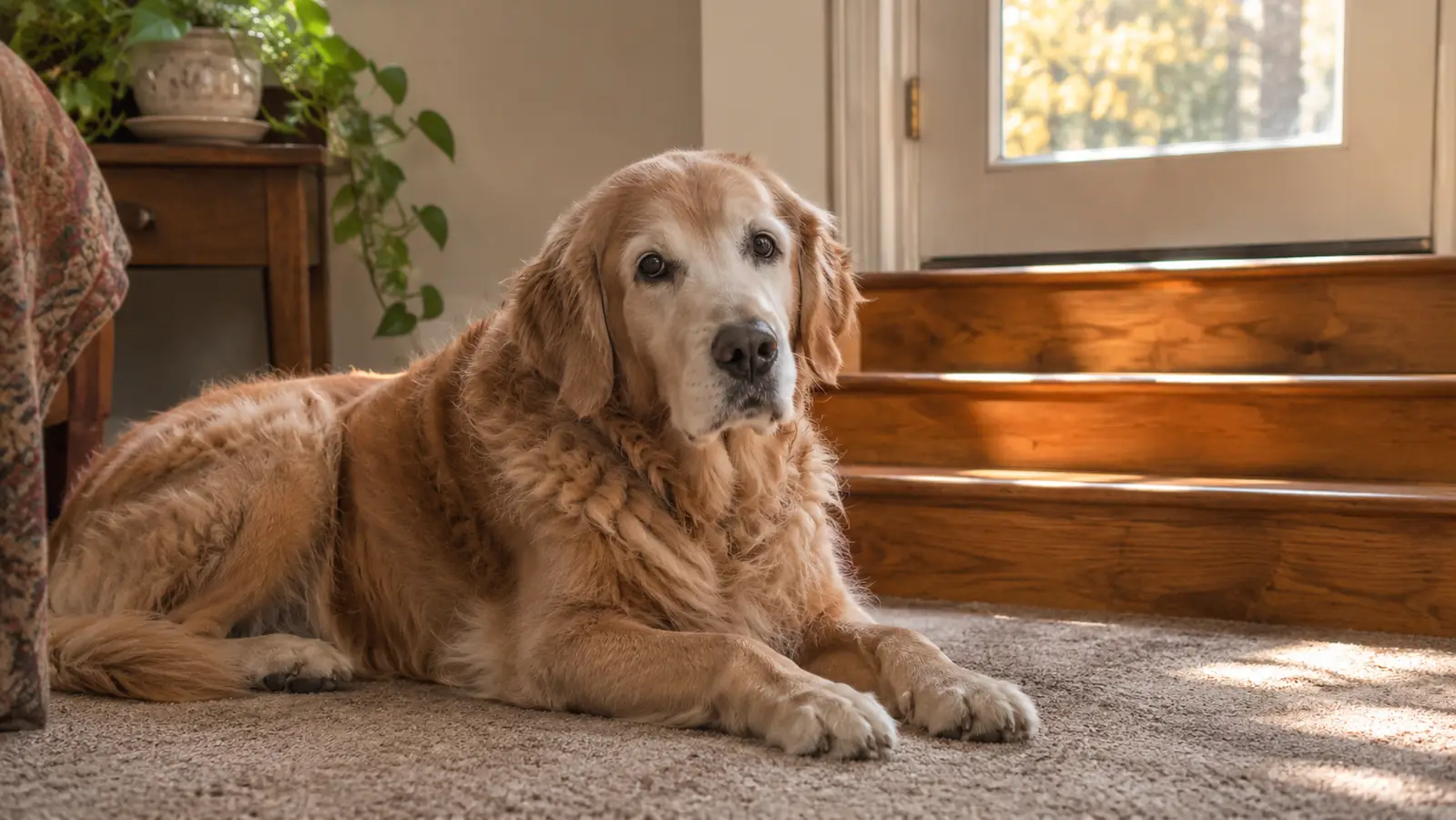
Our house is a single story ranch. The hall and the kitchen are oak hardwood, and there are three wooden steps down to the fenced yard at the back door. The bedroom is carpet, and carpet is the one surface in this house where Maple has never had a moment of trouble. It is the two hard floor rooms she crosses a dozen times a day that worried me, plus those steps. Bare paws on that oak were fine when she was four. At twelve, with arthritis in both hips, her back feet do not pick up the way they used to, and a foot that drags or lands wrong on a smooth board slides. That is the whole problem in one sentence. She did not need more strength. She needed friction.
I want to be clear about what these socks are and are not. They are a traction aid. A piece of fabric with a grip sole. They do not treat arthritis, they do not reduce inflammation, and they do not replace anything your vet recommends. What your vet prescribes for pain is a separate matter and one I am not qualified to weigh in on. I would have that conversation before I bought anything with a grip on the bottom, because a dog in real pain needs more than footwear.
Why socks and not grips, for her specifically? Three reasons. She is a big dog, so a nail only grip covers a small share of the surface that meets my floor. She tolerates things on her feet, so the main drawback of socks was never a drawback here. And she does not fuss at her paws, so the licking protection the listing talks about was not why I bought them, though I can see exactly how it would matter for a dog who worries at a sore foot. Those three reasons point one way for Maple. They will not point the same way for your dog, and that is the honest measure of this whole comparison.
Where DOK TigerToes Wins
Coverage comes first. The sock covers the whole paw, pads and all, and the pads are what touch the floor. A nail grip gives you a few small points of contact at the front of the foot. On a seventy four pound dog on a hard floor, I would rather have the whole pad engaged. The listing says the grip is built to work even when the sock twists, and I can vouch for the twisting part, because Maple's socks rotate. I straighten them a dozen times a day. In six months of that, I have never once found the grip end up on the side of her foot where it does nothing. That is the most useful thing about how these are made, because a sock that only worked in one position would be off her foot inside an hour.
Second, they are washable. Cotton and nylon, machine wash, and mine have gone through it more times than I can count. They come out the same shape and go back on the same afternoon. And third, the socks stay where I put them until I take them off. There is no reapplication at two in the afternoon because one came loose on the kitchen floor. For a woman who spent thirty years keeping track of other people's schedules, I do appreciate a job that stays done.
In six months on that oak hall she has not splayed again. I cannot prove the socks are the reason. I can tell you they were on her feet every single day.
Where Stick-On Toe Grips Win
Now the other side, and it is a real side. A stick-on toe grip attaches to the nail, so nothing wraps around the ankle or the wrist. For a dog who panics at the sight of anything on the foot, who kicks and bites and wins, that difference is everything. I have met dogs like that in other people's kitchens. You could not put a sock on them and keep your fingers. A grip on the nail is a two person job and some patience, and then it is done and the dog forgets about it.
Fit is the second advantage. Socks ask you to measure the paw and trust a chart. The Large in the DOK line is listed for paws two and a half to two and eight tenths inches, and Maple measured close to two and three quarter, so we sat comfortably inside that range. If your dog lands between sizes, or has a paw that no chart quite describes, socks get fussy in a hurry. Grips are trimmed to the individual nail, so the sizing question is smaller. And I will say plainly that on a humid July afternoon, when the oak in our hall goes tacky underfoot, a dog with nothing around the ankle has one less thing to think about. If your dog has swelling in the lower leg, or skin that cannot take pressure, ask your vet before you wrap anything around a paw.
The grip that keeps working after the sock has twisted
Maple measured about two and three quarter inches and wears the Large. Six months of daily wear, and the one slip on that floor happened before we started. Measure your own dog's paw first, then check today's price on Amazon.
Amazon Check Today's Price on Amazon →Before You Buy Either, Measure
For the socks, you need the paw, not the leg. Measure across the widest part while your dog is standing, because a standing paw spreads and a lying paw does not. Write the number down before you open the listing. Maple came out at close to two and three quarter inches. If you land between sizes, I would go up rather than down, since a sock too snug around the ankle is its own problem. Then spend a day watching how your dog stands. If the back feet knuckle under or scuff and drag, that is a different issue than slipping, and it belongs to your vet rather than to a piece of fabric.
For the grips, read the application directions on the listing before you order, and be honest with yourself about whether you will keep up with them. The dogs who do well with nail grips have owners who check them. The dogs who end up with a grip half off on the kitchen floor have owners who stopped checking. That is not a criticism, it is just how it goes. Whichever you choose, try one paw at a time on a hard floor and watch before you trust it on stairs or outdoors. Maple's first week in socks was hall only, twenty minutes at a time, and I am glad I did that.
What I Liked
- Covers the whole paw, so the pad is what meets the floor
- Grip holds even when the sock rotates, and on Maple it rotates constantly
- Machine washable and back on the same afternoon
- Stays on until you take it off, no mid-day reapplication
- Large is listed for paws 2.5 to 2.8 inches, which fit her at about 2.7
Where It Falls Short
- They twist and need straightening, sometimes a dozen times a day
- Indoors on hard floors only, not for wet or rough ground
- Some dogs will not tolerate anything around the ankle at all
- Sizing depends on measuring the paw accurately
Who Should Buy Which
Buy the DOK socks if your dog is already losing footing on hardwood or tile, will let you handle the feet, and needs the whole pad covered. If you have a big older dog who crosses a slick hall a dozen times a day, and you want the fix you put on once in the morning and take off at night, this is that fix. It is what I bought, and it is what is on Maple's feet as I write this.
Buy the toe grips if your dog will not wear anything on the foot, if the ankle is sensitive or swollen, or if you have a smaller dog where a nail grip is a fair share of the contact area. Buy neither, honestly, if your dog is knuckling, dragging a back foot, or showing new weakness, until your vet has seen it. Socks and grips are for a dog whose joints are stiff and whose feet still do what she asks of them. They are not a diagnosis and they are not a treatment. Maple sees Dr. Amari on a schedule, and I would not trade that for any product in this house.
Six months on the oak hall, and her feet still stay under her
DOK TigerToes, four socks to a pack, machine washable, Large listed for paws 2.5 to 2.8 inches. Measure the paw while your dog stands, then check today's price on Amazon.
Amazon Check Today's Price on Amazon →