
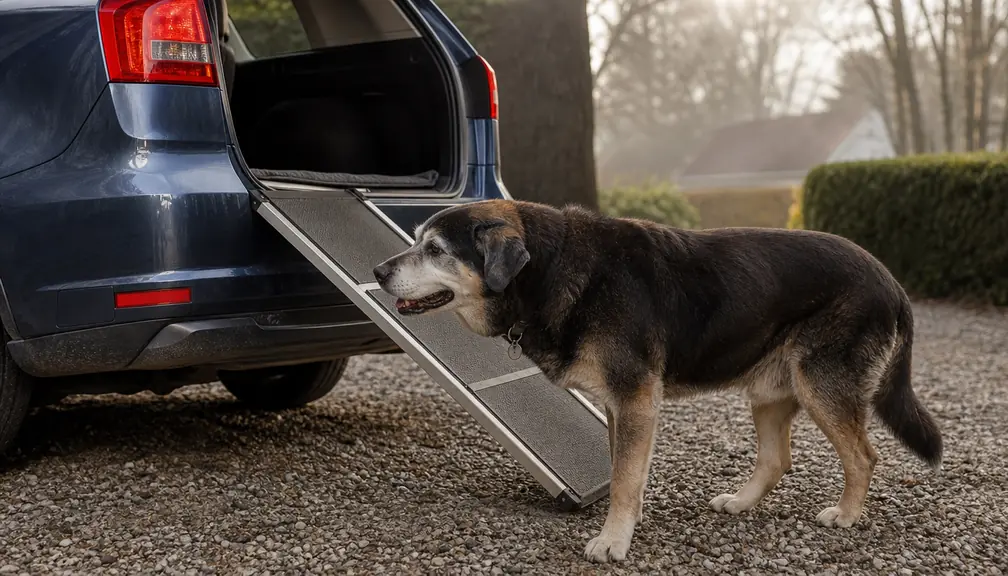
The first thing I noticed about the PetSafe Happy Ride Folding Dog Ramp was not the ramp. It was how much room it took up in the hall. I bought it the first week of August 2026 for Maple, my 12 year old spayed yellow Labrador mix. She weighs 74 pounds, and Dr. Amari diagnosed arthritis in both hips and her left elbow in February 2026. Before the ramp, Walt and I lifted her into the back of our 2018 Subaru Outback together. One of us took the front, one took the rear, and we counted to three. That worked until it did not. The PetSafe ramp gave us a third option.
I am not a veterinarian. I am a retired home health nurse in Hammonton, New Jersey, and I have spent a lot of years watching people and animals negotiate a bad step. I know what a safe transfer looks like, and I know when I am being sold a story. This is the honest version of what the ramp did for us, what it did not do, and the parts of the listing I wish I had measured before I ordered. Maple is still stiff. The ramp did not change that. It changed the car and the back steps.
The Quick Verdict
A sturdy 10 pound ramp that makes the Outback and the back steps easier on a 74 pound dog, but its 62 inch length is a real commitment and it will not replace a sling on a bad day.
Amazon Check Today's Price →The 62 inch length is the whole decision. Measure your hatch before you order.
The PetSafe Happy Ride is a bi-fold ramp with high-traction treads, side rails, rubber feet and a safety release latch. It weighs 10 pounds and is rated to 150 pounds. If your dog is already hesitant about a slope, plan on two weeks of treats, not two days.
Amazon See the PetSafe Happy Ride on Amazon →How I've Used It
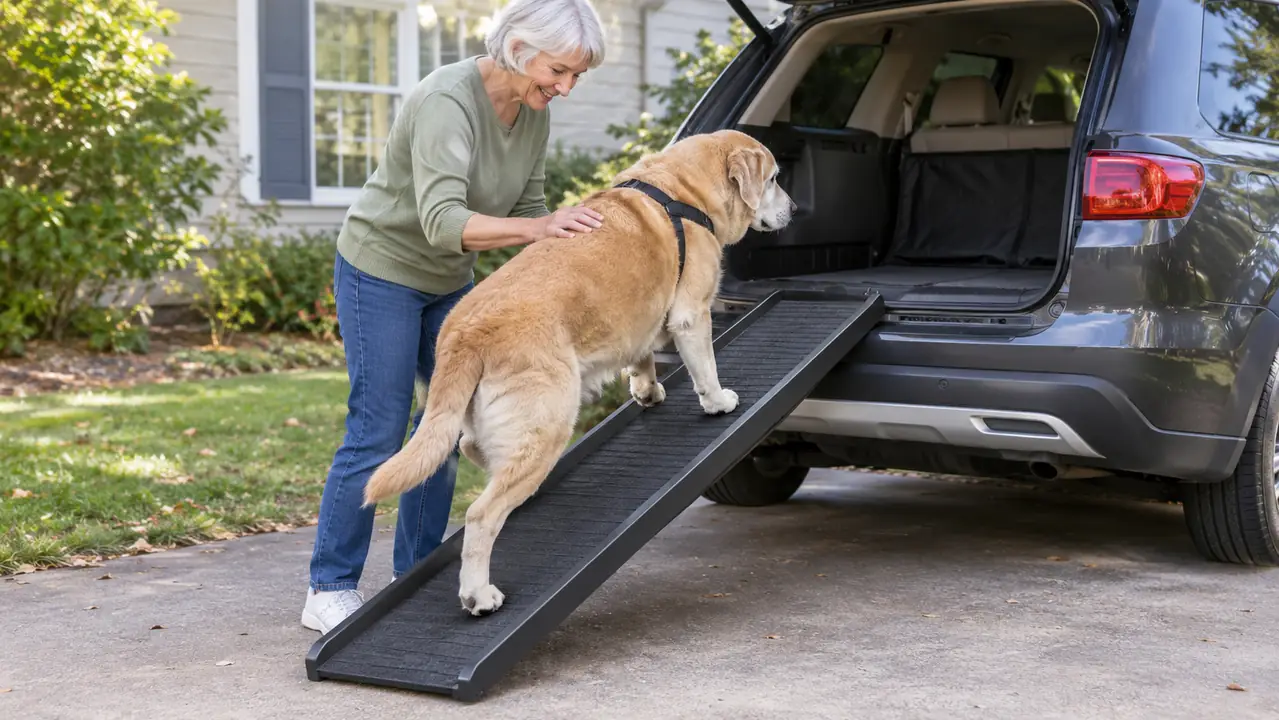
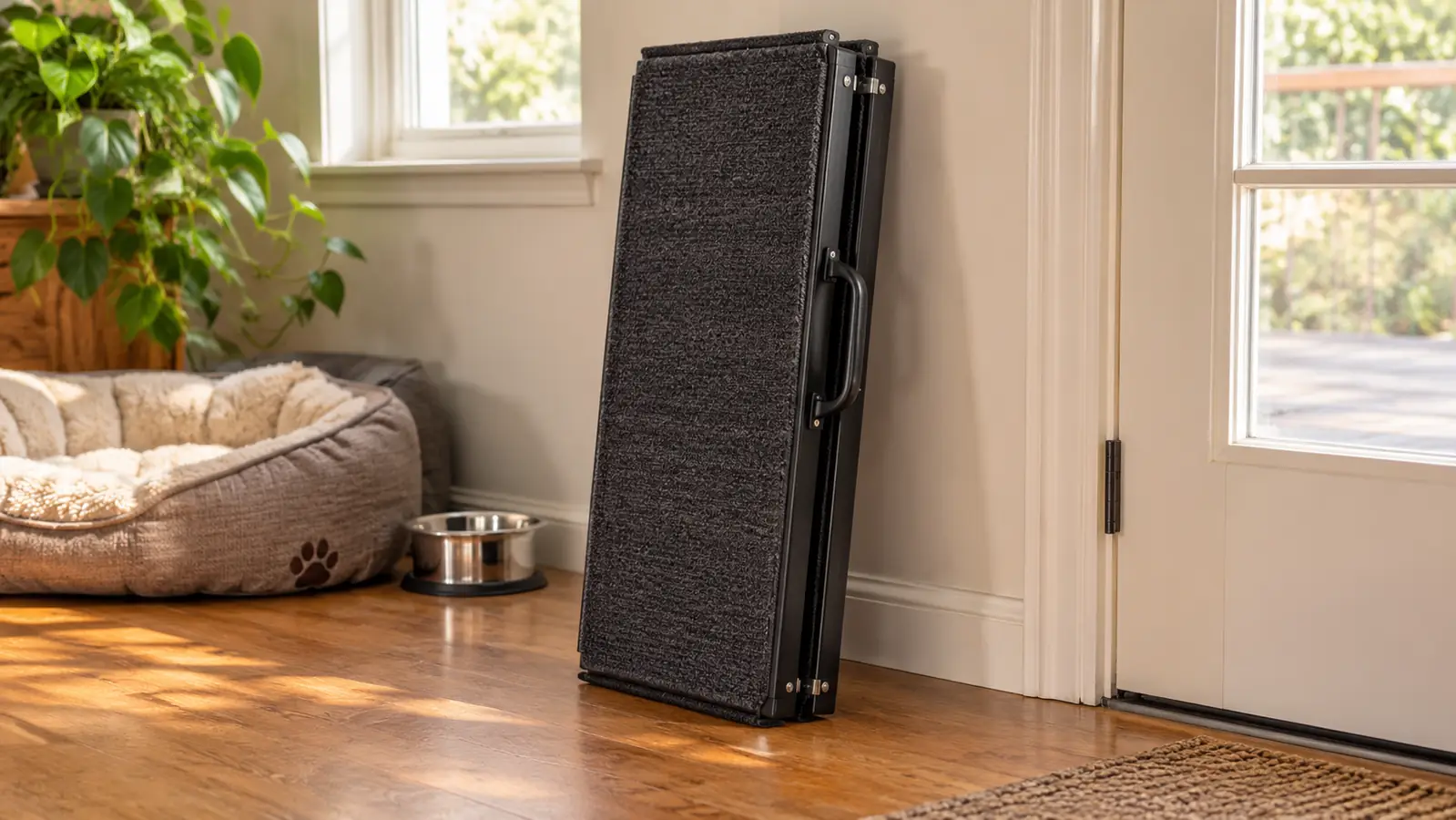
The ramp lives against the wall by the back door. It folds in half and stands on its end, which is the only reason it does not live in the garage. In the morning and again before bed, I set it on the three wooden steps at the back door so Maple can walk down to the fenced yard and back up without me holding her rear end. For vet visits, I set it against the rear hatch of the Outback. The rubber feet rest on the step and on the rear of the car. I check the safety release latch before she steps on. Then I stand at the side with my hand near her harness, not because the ramp needs me, but because Maple does.
The first week was not pretty. Maple stood at the bottom and looked at me like I had lost my mind. She is a Labrador, so food helps. I put a treat on the first third of the ramp, then the middle, then the top. It took about two weeks before she walked it without hesitating. I did not rush her, and I did not pick her up and place her on it. If your dog is more anxious than Maple, give it more than two weeks. A ramp is not a command. It is a piece of furniture your dog has to decide to trust.
What I use it for is narrow on purpose. It is for the Outback and the back steps. I do not use it inside the house. We have oak hardwood in the hall and kitchen, and that is what the traction socks are for. The ramp is not a substitute for the sling on a bad day. Since August, the ramp has handled the steps most days, and the LOOBANI sling comes out when Maple is stiff. That is the routine. The ramp is one part of it.
The first time I set it on the back steps, I put it on the middle step and let Maple sniff it. She walked around it. I did not force her. The next morning I put a treat at the bottom and she took it. The morning after that she put one paw on the ramp. That is how it went. If you have a dog who is food motivated, the ramp is a training exercise. If you have a dog who is not, you may need a different plan. I am not a trainer, and I am not going to pretend this works for every dog.
The 62 Inch Length Is the Real Decision
The listing says 62 inches long, 16 inches wide and 4 inches high. I read those numbers before I ordered, but I did not measure my Outback. I should have. On the rear of the car, the length is what makes the slope gentle enough for Maple to walk instead of scramble. A shorter ramp would be steeper, and a steeper ramp is harder on her hips and elbow. That is the trade. The 62 inches buys you a kinder angle.
The length is also the thing that makes the ramp awkward. In our hall, it is not a small object. Folded, it is still 62 inches long, and it stands against the wall like a folded table. If you have a tight garage or a narrow mudroom, measure that space too. The ramp is 10 pounds, so I can carry it with one hand, but 62 inches is 62 inches. I have caught the end of it on the doorframe more than once.
On the back steps, the long length does something different. The three steps are short, so the ramp reaches past the bottom step and gives Maple a longer, shallower run. That is good for her. It also means the ramp takes up more of the walkway. Walt has to step around it when he comes in with groceries. If your back steps open onto a narrow path, the ramp may block the path. That is not a defect. It is geometry. Measure the path, not just the dog.
I measured the Outback after the ramp arrived, which is backwards. The rear opening is lower than I thought, and the 62 inch ramp gives a slope that is closer to a gentle hill than a ladder. On a taller truck, the same ramp would be steeper. The listing says it fits most SUV, van, car and truck models. I can only speak to the Outback. If you have a tall tailgate, set the ramp up before you buy and look at the angle. A 62 inch ramp on a tall truck is not the same slope as a 62 inch ramp on a wagon.
Grip, Side Rails and What I Still Watch
The high-traction treads are the reason I chose this ramp over a plain board. On dry mornings, Maple's paws do not slide. I have not used it in snow, ice or heavy rain, so I cannot tell you how it behaves in those conditions. I can tell you that wet leaves in October made me nervous, and I wiped the treads before I let her on. If you live where winter is real, treat the treads like any other outdoor surface. Keep them clear.
The side rails give Maple a visual edge. She can see where the ramp ends. They are not a fence. If a dog bolts or tries to step off the side, the rails will not catch a 74 pound body. I stay at her side and keep my hand near her harness. That is not because the PetSafe ramp is flimsy. It is because a 12 year old dog with arthritis can lose her balance on a flat floor. I am not going to pretend a ramp solves that.
The rubber feet and the safety release latch are the two parts I check every time. The feet keep the ramp from sliding on the step and on the rear of the car. The latch is the part that keeps the ramp from folding while it is set up. I do not know what happened to the people who left poor reviews, but I can guess that some of them did not have the feet flat or did not have the latch engaged. That is not an excuse for a bad unit. It is a reason to slow down the first time you set it up.
Maple's paws are not what they were at four. She has less grip in the back, and she does not pick her feet up as high. The treads help, but they do not change her. I still watch her back feet. If she starts to drag a toe, I stop and reset her. The ramp is not a conveyor belt. It is a surface. You still have to pay attention.
Weight and Storage: 10 Pounds Is Manageable, 62 Inches Is Not Small
The ramp weighs 10 pounds and is rated to 150 pounds. Maple is 74 pounds, so there is margin. I am 65 and I can lift it with one hand, but I do not carry it far. The listing does not list a handle, so I carry it by the middle of the folded ramp. That works for the ten feet between the wall and the back door. It would not work for a long walk to a park.
The folded ramp stands on its end against the wall. It is 4 inches high when folded, according to the listing, and 16 inches wide. That is thin enough to tuck behind a door, but it is not invisible. If you have a small house, you will see it every day. I would rather see it than lift Maple into the car, so I made peace with it. The one year warranty is on the listing. I have not had to use it.
When we travel, the ramp goes in the back of the Outback under the cargo cover. It takes up space. If you need the full cargo area for luggage, the ramp is another thing to pack. I have not taken it on a long trip. I have only used it for vet visits and the back steps. That is enough for us. It is not a piece of equipment I would want to set up in a hotel parking lot after dark.
What It Does Not Do
The ramp does not treat arthritis. It does not make Maple younger, and it does not stop the stiffness I see when she first stands up after a nap. Dr. Amari diagnosed the arthritis. The ramp is a tool for loading and steps. That is all it is. If you are looking for something that changes the joint, talk to your vet. Do not buy a ramp and call it a plan.
The ramp also does not replace the sling on a bad day. Maple has good days and stiff days. On a stiff day, she needs the support under her belly, not just a slope. The ramp handles the car and the back steps most days. The sling comes out when she needs it. If you buy the ramp expecting to throw away the sling, you will be disappointed. I still keep both by the door.
The last thing it does not do is train your dog. I did the treat work. I stood there in the morning and waited. Maple decided the ramp was safe after about two weeks. If you are not willing to do that, the ramp will sit against the wall. That is not the ramp's fault. A ramp is a tool, and a tool needs a handler. The PetSafe Happy Ride is well made, but it cannot make the decision for your dog.
I want to be plain about the vet part. Dr. Amari diagnosed arthritis in both hips and the left elbow. She did not tell me to buy a ramp. She told me to keep Maple moving and to make the car and steps easier. The ramp is my version of that advice. It is not a treatment, and I would not want anyone to read this and skip a vet visit because a ramp seemed simpler. It is not a substitute for a diagnosis. It is just a tool.
What I Liked
- 10 pounds, so a 65 year old woman can move it alone
- 62 inch length makes a gentle slope for a 74 pound dog
- High-traction treads and rubber feet feel stable on dry days
- Folds and stands against the wall by the back door
- Side rails give the dog a visible edge
- Rated to 150 pounds, with margin for Maple
Where It Falls Short
- 62 inches long, so it is awkward in a narrow hall or mudroom
- Side rails will not stop a dog that tries to step off
- Treads need to be kept clear of wet leaves and snow
- Does not replace a sling on a bad day
- Two weeks of treat work before Maple would walk it
- I have not used it in ice, so I cannot vouch for winter
The ramp did not make Maple younger. It made the Outback something I could manage alone on a Tuesday morning.
Who This Is For
This ramp is for a dog who is already hesitant about a steep jump into a car or a short set of steps, and for a person who is tired of lifting. It suits a dog in the 50 to 100 pound range who will take treats and learn. It also suits a household with one consistent handler who will set it up the same way every time. If you have a 2018 Outback or a similar wagon, the 62 inch length gives you a slope that a stiff dog can walk. The PetSafe Happy Ride is not a small accessory. It is a daily piece of equipment, and it works best when you treat it that way.
Who Should Skip It
Skip it if you have a dog who panics on a slope and you are not prepared to train. Skip it if your hall or mudroom has no wall space for a 62 inch object. Skip it if you expect the ramp to replace your vet, your sling or your traction socks. And skip it if you need something you can fold into a glove box. This is a 10 pound ramp, not a blanket. It is also not the right first step for a dog who cannot stand. If Maple could not stand, I would be talking to Dr. Amari about support, not shopping for a ramp.
If you are still lifting a 74 pound dog into the car, measure your hatch and give the ramp two weeks.
The PetSafe Happy Ride is 62 inches long, 10 pounds, and rated to 150 pounds. It has high-traction treads, side rails, rubber feet and a safety release latch. It is not a cure for arthritis, and it is not small. It is a practical tool that made our morning routine easier.
Amazon See the PetSafe Happy Ride on Amazon →