
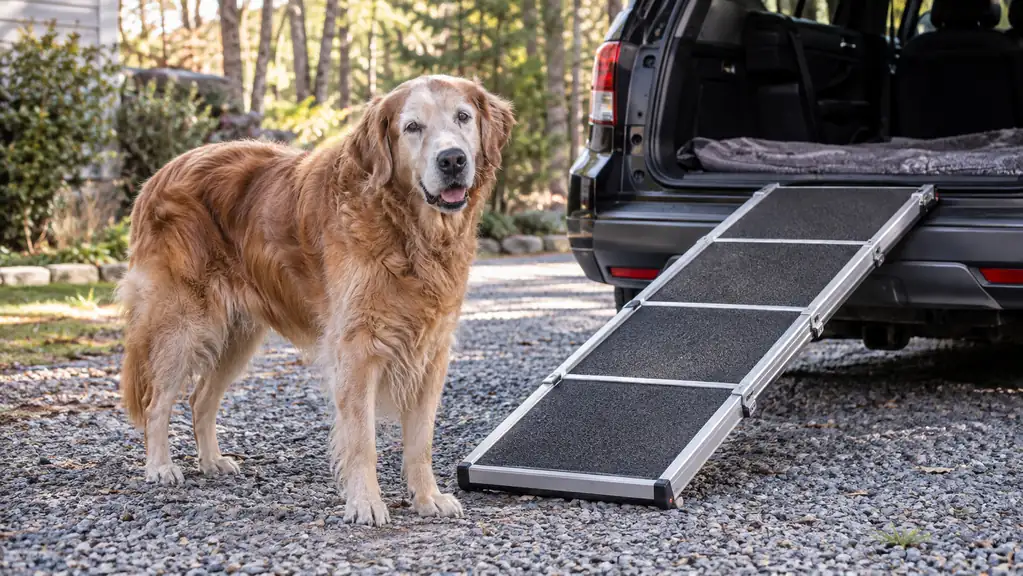
Maple is a 12-year-old spayed female yellow Labrador mix, 74 pounds, and in February 2026 her vet found arthritis in both hips and the left elbow. For years she had managed the three wooden steps at our back door and the jump into our 2018 Subaru Outback. Then the jump turned into a lift. Walt took her front, I took her rear, and the two of us hoisted her into the cargo area. That was not a safe routine for a 74-pound dog or for two people who are not getting younger.
We bought the PetSafe Happy Ride Folding Dog Ramp the first week of August 2026. It has been three months. Maple now walks up and down it for her morning and evening yard trips, and she uses it at the rear hatch of the Outback for vet visits. It took about two weeks of treats before she walked it without hesitating. This is the sequence that worked for us, in plain terms. I am not a veterinarian. If your dog is limping, guarding the sore leg, or seems painful, call your vet before you start ramp training.
The ramp that got Maple out of the two-person lift
The PetSafe Happy Ride Folding Dog Ramp is the one we keep by the back door. It is 62 inches long, 16 inches wide, weighs 10 pounds and is rated to 150 pounds. Check it on Amazon if you are facing the same lift.
Amazon See the PetSafe Happy Ride Folding Dog Ramp on Amazon →Step 1: Get the vet's okay and choose the spot you will practice in
When I asked Dr. Amari whether a ramp was reasonable for Maple, she said it was worth trying for the car and the back steps. She also reminded me that a ramp is a tool for getting from one place to another, not a treatment for arthritis. That matched what I already believed. If your dog has a diagnosis, ask your vet to check the sore joints and tell you whether a ramp, a sling or a different setup is safer for your dog. I am not in a position to make that call for anyone else's dog.
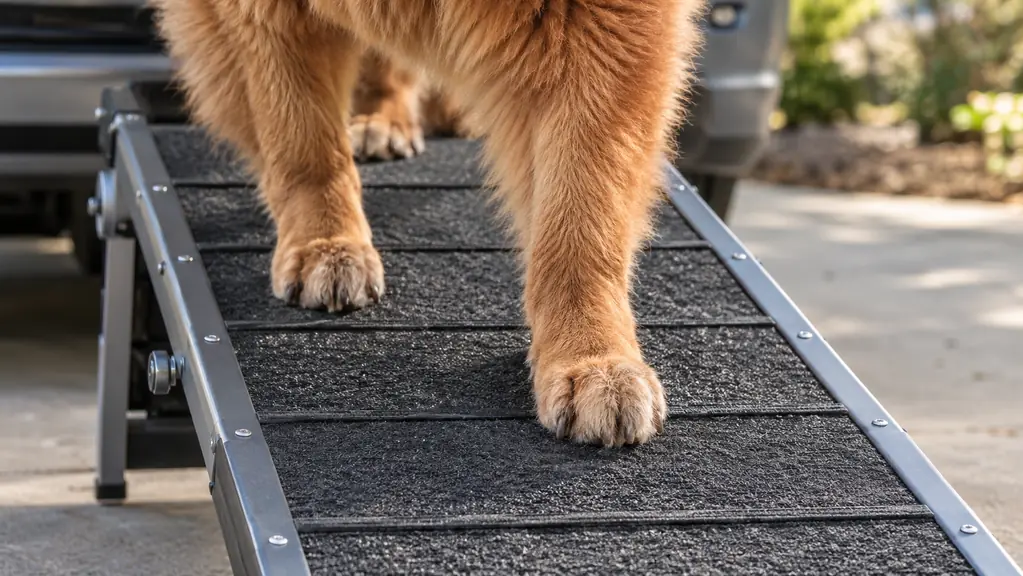
The second part is picking one spot. Do not start with the car if your dog has never seen a ramp. Do not start with a steep angle. For us, the first spot was the bedroom carpet. It was flat, it was quiet, and Maple already liked being in there. The ramp is plastic and it has high-traction treads, side rails, four rubber feet and a safety release latch. On carpet the rubber feet sat still. I could kneel beside her without crowding her.
The ramp measures 62 inches long, 16 inches wide and 4 inches high when folded, and it is rated for 150 pounds. Maple is 74 pounds, so weight was not the concern. The concern was that she would feel the ramp move under her and refuse it. A flat, stable start gave her one less thing to think about. If you have a senior dog with arthritis, that is the whole point of this step: reduce the number of new things at once.
Step 2: Let her inspect it with no destination and no pressure
The first session lasted about three minutes. I set the ramp on the bedroom carpet and put a few pieces of her regular kibble at the low end. I did not stand at the far end and call her. I did not pat the ramp. I sat on the floor and read a book. Maple came over, sniffed the edge, took a piece of kibble and backed off. That was enough for day one.
On day two I put the kibble a little farther onto the ramp. She put one front paw on, stretched her neck, took the food and stepped back. I did not push. A dog with arthritis has already learned that some movements hurt. If you add pressure, you teach her that the ramp is another thing to brace against. Let her choose the first step, then the second.
I kept the sessions short, five minutes at most, and I stopped while she was still interested. If she walked away, I put the ramp aside and tried again later. We did this twice a day for three days. By the end of the third day she would stand with all four feet on the flat ramp to get a piece of kibble. She was not walking across it yet. That was fine. The goal of this step is not travel. It is a dog who believes the ramp is a food place, not a trap.
Step 3: Teach a flat crossing before you add any height
Once Maple would stand on the ramp, I began to lure her across it while it stayed flat on the carpet. I put a piece of kibble at the near end, one in the middle and one at the far end. I kept my hand low and quiet. I did not hold her collar. If your dog wears a harness, a light leash can keep her from wandering off, but keep it slack. A tight leash pulls a dog off balance, and balance is the thing you are trying to build.
The side rails helped. They are low, but they give a dog something to feel on either side. The high-traction treads also helped on the carpet because her nails did not skate. The first full crossing took her about ten seconds. She stopped in the middle, looked at me, and then kept going for the food. I made a quiet fuss over her and ended the session.
We practiced the flat crossing for four days. By day four she crossed without a treat in every position. I still gave her one at the end. This is the point where a lot of people rush. They go from a flat ramp on the floor to the back of a car in one afternoon, and the dog balks. I would rather spend four days on the carpet than a month repairing a bad first impression. Maple is a steady dog, and she still needed the repetition.
It took Maple about two weeks of treats to walk the PetSafe ramp without hesitating. It did not cure her arthritis. It stopped us from lifting 74 pounds into the Outback.
Step 4: Raise the angle at the back steps, not the car
Our back door has three wooden steps down to a concrete pad and a fenced yard. Before August, those steps were a LOOBANI sling job on her stiff days. I bought the PetSafe ramp for the car, but once Maple was crossing it flat, I tried it on the steps. I set the top of the ramp at the top step and the bottom on the concrete pad. I checked that the rubber feet were flat and that the safety release latch was engaged. Then I walked beside her on the grass side, not in front and not behind.
The first trip down was slow. She stopped halfway, and I let her stop. I did not tug the leash or lift her belly. I waited until she took one more step, then gave her a piece of kibble. The next morning she went down with one pause. By the end of the week she was using the ramp for both the morning and evening trips. The angle at three steps is mild, which is why it was a better second location than the Outback.
This is also where the ramp's size matters. At 62 inches long, it covers the three steps with room to spare. At 16 inches wide, Maple has a clear path without her feet hanging over the edge. The ramp is rated to 150 pounds and weighs 10 pounds, so I can move it myself. I am 65, and I do not want to wrestle a heavy piece of equipment twice a day. I set it in the morning and leave it until after the evening trip.
Step 5: Practice the vehicle with two people, then one
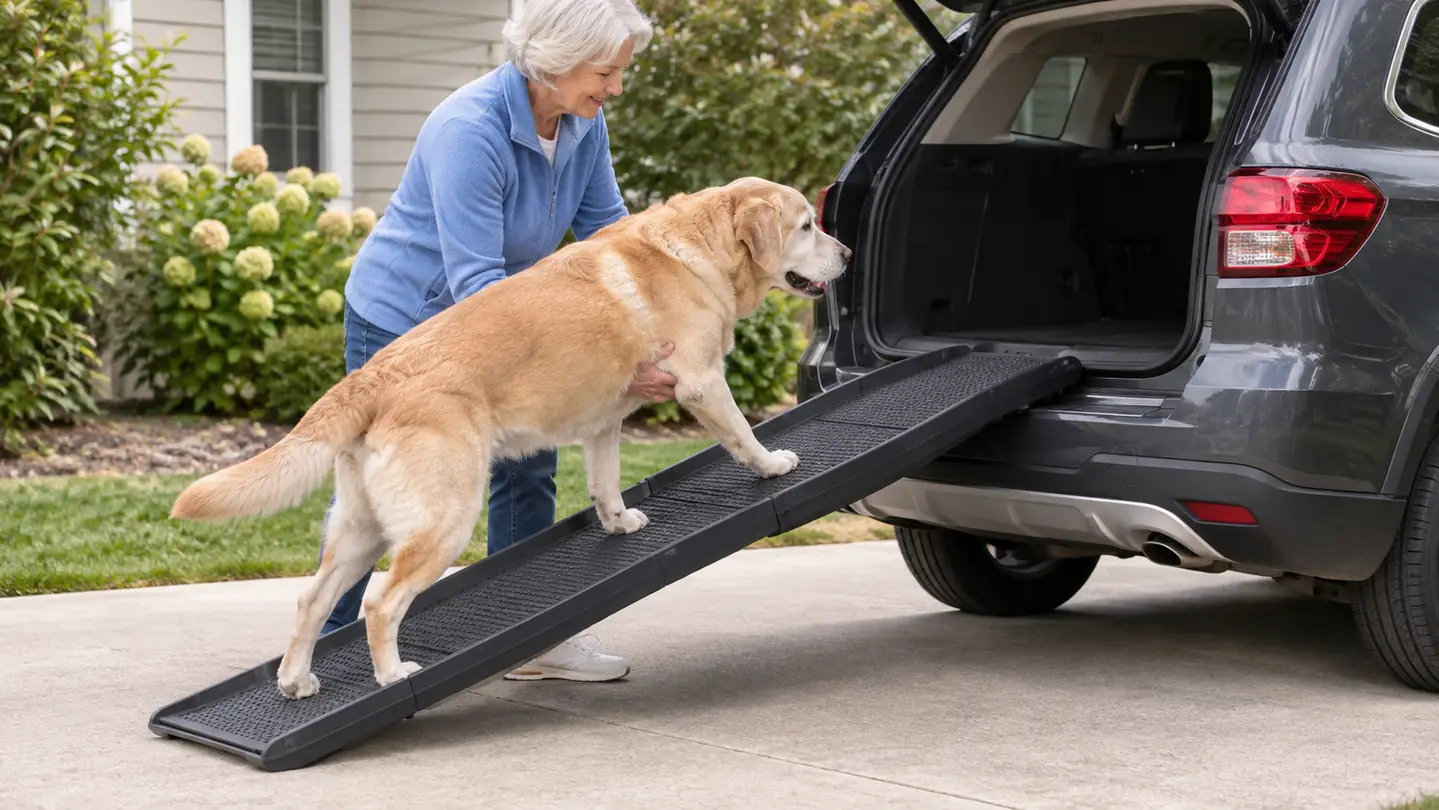
We practiced the Outback on a Saturday morning in the driveway, not on the way to an appointment. I parked on level ground, opened the rear hatch and set the ramp against the bumper. Walt stood on the far side the first two times. I stood at Maple's shoulder. Neither of us lifted her. She walked up, got a piece of kibble in the cargo area, turned around and walked down. We did that three times and quit.
The next day Walt stayed in the house. I set the ramp myself. The PetSafe ramp weighs 10 pounds, so this was not a struggle. I checked the rubber feet and the safety release latch, then I let Maple take her time. She went up without a pause and came down with one. After about two weeks of short sessions, she was walking the ramp without hesitating. That was the point where I stopped using a treat on every trip. Now she gets one at the top sometimes, and sometimes she does not.
Three months in, this is our routine. The ramp stands inside against the wall by the back door. For yard trips I set it on the back steps. For vet visits I set it against the rear hatch of the Outback. I do not use it on wet grass or ice. I do not leave it out in the rain. I check the rubber feet and the latch each time I move it. None of that is complicated. It is just the same check I would do with a step stool before I climbed on it.
What Else Helps
The ramp solved one problem: height. It did not solve the oak floor in the hall and kitchen. In April 2026 Maple's back legs splayed on that floor one morning. She was not hurt, but it scared me. That is why we bought the DOK TigerToes socks in May. She wears them indoors during the day and they come off at bedtime. They twist sometimes and need straightening. They are not a cure. They gave her a little more grip on the slick wood.
The LOOBANI lift sling is still by the door. It is a padded sling under the belly with handles, for the rear end only. Before the ramp, it was a daily part of the back steps on her stiff days. Now the ramp handles the steps and the sling comes out only when she is having a bad morning. That is a real change. It is also not a reason to skip the vet. If your dog is suddenly worse, or if she is reluctant to bear weight, that is a veterinary conversation, not a ramp conversation.
Maple started Cosequin chewable tablets the first week of March 2026 at Dr. Amari's suggestion. She has been on them for eight months, once each morning with breakfast, the amount the package directions give for her weight. I first noticed easier morning rising around mid-April, about six weeks in. The change was modest. She still has stiff days. I am not going to tell you a supplement is why she uses the ramp. I am telling you what we do, in order, so you can see the whole routine. The bed is a Bedsure SupportMax XL on the carpet on my side of the bedroom. The cover comes off and goes in the wash about every two weeks. A soft, warm place to land after a ramp trip is not a small thing.
One more thing: keep the nails trimmed. I am not a groomer, and I am not going to pretend this is a technical instruction. Long nails change how a dog's foot meets the ground. Ask your vet or your groomer what your dog needs. And keep the ramp clean. Kibble crumbs and grit do not help the treads. I wipe ours down when it looks dirty, and I check the rubber feet for wear.
If your dog is still being lifted into the car, start with the flat ramp
The PetSafe Happy Ride Folding Dog Ramp is the one we bought in August 2026. It is 10 pounds, 62 inches long and rated to 150 pounds. It folds and stands by our back door. Check it on Amazon, then ask your vet whether a ramp is right for your dog's joints.
Amazon Check availability on Amazon →