

The first thing I noticed was not a limp. It was that Maple stopped getting up on her own in the morning. For eleven years she had been the dog who was awake before I was, clicking down the hall while I was still finding my slippers. Then last winter she started lifting her head, looking at the floor, and lying back down for another ten minutes. Dr. Amari diagnosed arthritis in both hips and the left elbow in February. Maple is a twelve year old spayed yellow Labrador mix, seventy-four pounds, and she is the first and only dog I have ever owned. I say that so you know what you are getting here. Not an expert. A woman who spent thirty years as a home health nurse and then had to figure out how to help her own dog get off the floor.
What changed her mornings more than anything else in this house was a bed. Not the thin flat department store thing she had slept on for years, which went to the curb, but a thick orthopedic one. We bought the Bedsure SupportMax in extra large in the middle of April, and I set it up over about three evenings, mostly by watching where Maple already wanted to lie down and then moving furniture to match. Seven months later it sits on the same patch of carpet on my side of the bedroom, and I have washed the cover roughly every two weeks since. Here is how I would do the whole thing again, in order.
Seven months on the same patch of carpet, and the cover still unzips in one piece
The Bedsure SupportMax is the bed Maple has slept on every night since April. Rectangular bolster, non skid bottom, a cover that detaches completely instead of fighting you in the wash.
Amazon Check Today's Price on Amazon →Step 1: Put it where she already lies down, not where you think a dog bed belongs
My first instinct was the corner of the living room, because that is where a dog bed looks like it belongs in a house. Maple had other information for me. She was already choosing the floor on my side of the bedroom, near the wall, where she could keep her back against something solid. So that is where the bed went. If your dog has already picked a spot, that spot is the answer and your only job is to give her better flooring there.
Two things to check before you commit. Carpet beats hardwood for this. Maple's back legs went out from under her on the oak hall floor one morning in April, and while she was not hurt it frightened us both. A soft bed on a hard floor can skate when a stiff dog pushes off it, so hers sits on carpet. Second, leave a clear straight run to the spot. She needs to be able to walk up to the bed without first turning around on something slippery, because the turn is where an arthritic dog loses her footing.
Also measure before you order, honestly, with a tape. I laid the tape along the kitchen floor while Maple stood still for a piece of cheese, base of the neck to base of the tail, and wrote the number on the back of an envelope. The extra large is 45 by 32 inches and about nine and a half inches tall, which is taller than it sounds on a screen. For a seventy-four pound dog that is a step up, not a flop down. Keep that in mind for what comes next. Once the bed was down I moved a nightstand about a foot and slid the laundry hamper out into the hall, so she had four clear feet of straight carpet to walk on before she had to turn at all. That was Walt's idea and it was a better one than mine.
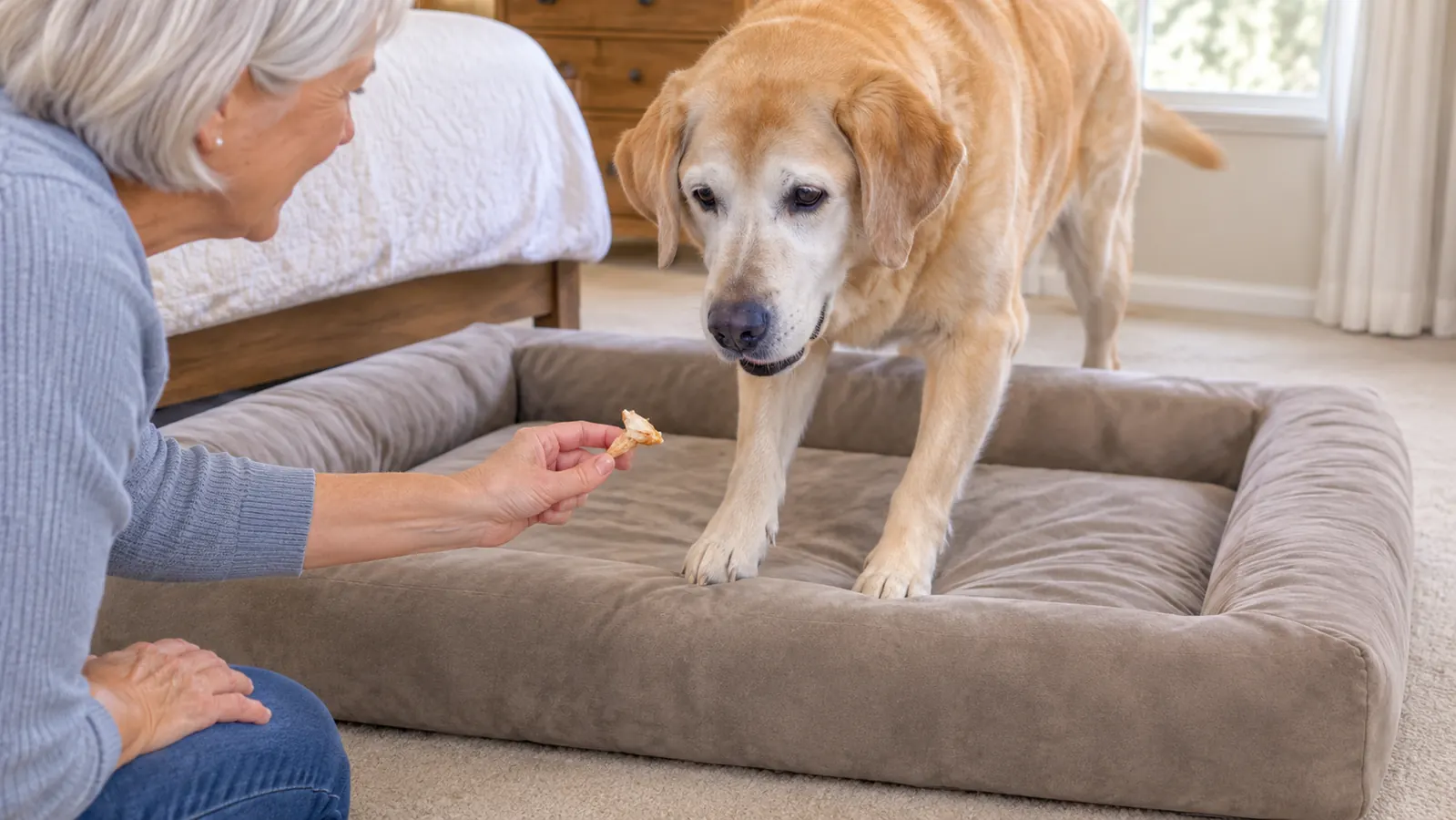
Step 2: Make it steady, then make getting on it worth her while
Before Maple ever touched it, I pressed down hard on all four corners. It weighs a little over fifteen pounds, with a shredded foam and cotton blend base, so it does not skate the way her old flat bed did, and the bottom is a non skid surface. That steadiness matters more than the cushioning for an unsteady dog, because the danger is not the bed shifting while she sleeps. It is the bed shifting while she is climbing onto it.
Then I cheated. I put a small piece of plain cooked chicken on the bed and let her find it. She stepped up with her front feet, took the chicken, stepped back down, and we did that four times that first evening. Four reps was plenty. The next night she put all four feet on. By the fifth night she walked over to the bed on her own after her last trip outside, stood there a second, and climbed on with no chicken at all. I stood in the doorway and said nothing, which was harder than it sounds. The night after that she lay down without being asked. That was the whole training program. No lifting and no coaxing with both hands. Lifting a dog with sore hips is how you get bitten by the sweetest dog you know, and it also teaches her that the bed is something that happens to her rather than something she chooses.
If your dog flatly refuses to step up, do not force it and do not build a workaround out of cushions. Watch her for a full minute rather than a glance, because what you are looking for is whether she puts weight on the back legs when she turns, and that takes longer than a glance to see. Then call your vet. There is usually a reason past stubbornness, and it is worth knowing what it is before you spend another evening on the floor with a piece of chicken.
Step 3: Let the raised edge do a job you did not hire it for
This bed has a raised bolster along the edges, and that edge turned out to be the part that mattered most. Maple sleeps with her head up on it. When she wants to get up she pushes her nose and chest into it and rocks herself forward, instead of trying to haul her back end straight up off a flat surface. I did not plan any of that. I noticed it in the second week and I have watched her do it nearly every morning since. If you are shopping for a bed for a stiff dog, look for that raised edge. It is worth more than an extra inch of foam.
Sizing is the one place I would not copy me. The listing gives five sizes from thirty-five to forty-eight inches. Measure your dog from the base of the neck to the base of the tail and take that number to the chart rather than going by weight alone, because two dogs at seventy-four pounds can be three inches apart in length. Maple has room to spare in the extra large. A much longer dog would want the bigger end of the range, and a dog under fifty pounds would be swimming in it.
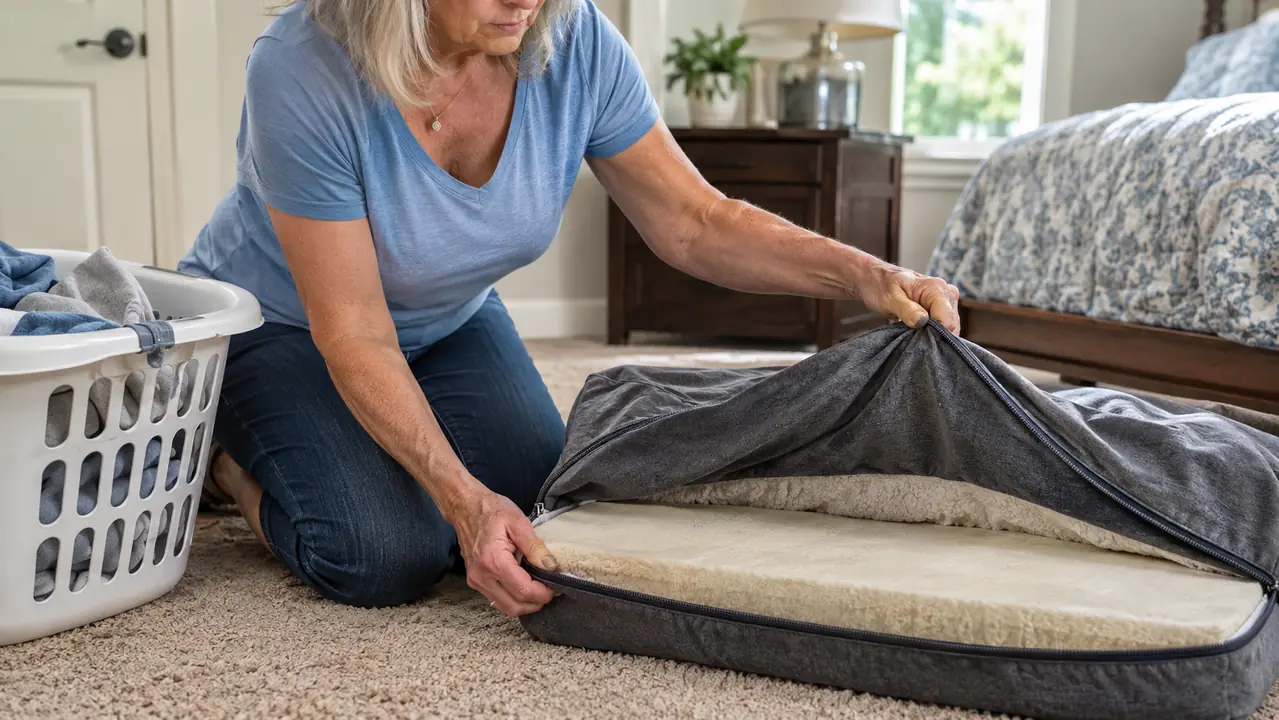
Step 4: Keep it clean without taking the whole bed apart
The cover comes off completely, bolster and all, and that single detail is the reason I would buy this bed again. Her old bed had the sides sewn in, so washing it meant wrestling a wet soggy donut into the machine and hoping the filling survived. This one unzips and the foam stays out of the laundry entirely.
I wash the cover every two weeks, which sounds fussy right up until you have an older dog who drools in her sleep. Two weeks is simply what worked out here, and it fits a laundry load. The first wash, back in April, I half expected the zip to give out and it did not. I shook the cover out over the porch rail first, because a winter of Labrador hair comes off better dry than wet, then cold washed it and hung it over the shower rod overnight. In between washes I vacuum the whole thing with the brush attachment and wipe up anything wet straight away, because the Bedsure cover is water resistant, not waterproof, and I would rather not test the difference. Mine has been through the machine around fourteen times now and the zip still works.
Step 5: Judge it after six weeks, not six days
Here is the honest part. The bed did not make Maple younger and it did not fix her hips. What it did was change the first fifteen minutes of her day. In March she would get up in stages, hind end first, then a pause, then the front. By the end of May she was rising in one motion most mornings. On a damp morning she still takes it slow. That is arthritis, and a bed is not a treatment for arthritis. It is a better surface to sleep and stand on.
So give it six weeks before you decide, and keep a note on the fridge. Every Sunday I wrote down three things: how she got up, how far she walked that week, and whether she hesitated at the back door. Six weeks of that will tell you more than any single morning will, because the changes are small and by June you will not accurately remember March. My note for the last Sunday in March says three tries, hind end first, went back to bed. The one for the second Sunday in May says up in one go, walked to the mailbox and back, no pause at the door. I would not have believed those were the same dog if I had not written them down. If she is worse rather than better, or if she starts guarding one leg or yelps when you touch her, that is a call to your vet, not a reason to shop for a different bed.
What Else Helps
The bed is the floor under her. It is not the whole plan, and I would be lying if I said it was. Maple takes a chewable joint supplement each morning with her breakfast, the amount the package directions give for her weight, on Dr. Amari's suggestion. She started it in the first week of March and I first noticed easier mornings around the middle of April, about six weeks in. The change was modest. She still has stiff days and I do not pretend otherwise. I keep the bottle beside the bag of kibble in the pantry so I do not forget it, because I am the one who forgets things at seven in the morning.
For the floors, she wears traction socks indoors during the day and they come off at bedtime. I bought them after that April morning on the oak hall. They twist and I have to straighten them, but the hall is no longer a place she avoids. On her stiff days I use a padded sling under her belly to help her rear end up the three back steps. Since August a folding ramp handles those steps and the back of the Outback most days, and the sling comes out only when she is having a bad one. The ramp took her about two weeks and a good number of treats to trust.
None of that replaces your vet. I am not one and I am not going to pretend to be. Ask about pain control, ask about her weight, and ask what you should be watching for month to month. Maple could stand to lose three pounds and that is on me, not on the bed.
She pushes her nose and chest into the raised edge and rocks herself forward instead of hauling her back end up off the flat. I did not plan that. I just watched it happen in the second week and started paying attention.
If you only do one thing for a stiff dog's sleep, start with the floor under her
Maple's Bedsure SupportMax sits on the carpet on my side of the bedroom, washed every two weeks, seven months in and still in one piece. Measure your dog from neck to tail base before you pick a size.
Amazon Check Today's Price on Amazon →