
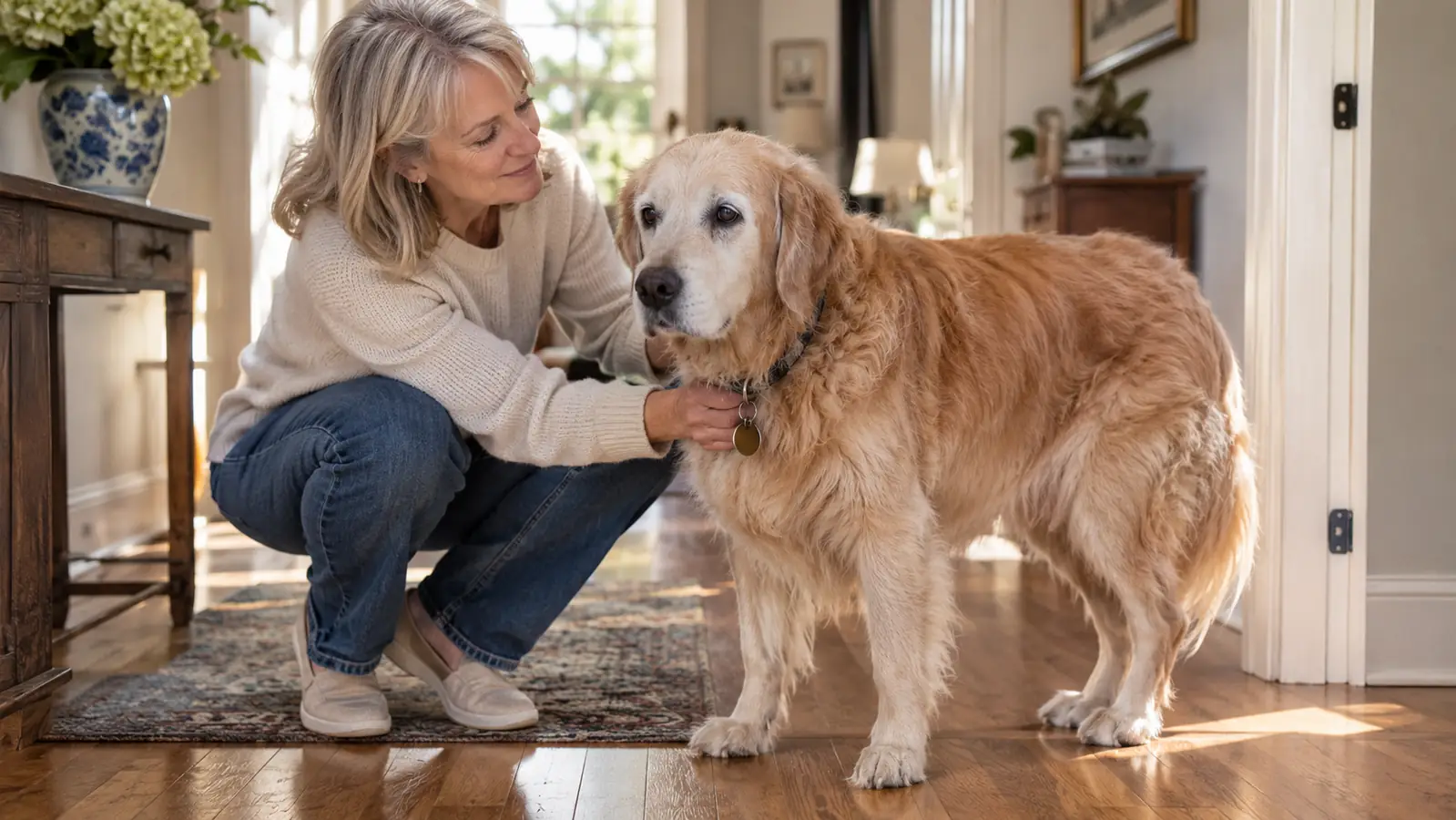
The first time I timed Maple getting up off the bedroom carpet, it took her three tries. She rocked forward, sat back down, rocked again, and then pushed up with her front end and dragged her back legs under her. That was January. By February she was doing the same thing on the oak floor in the hall, only slower, and I had stopped telling myself it was the cold weather.
Maple is a twelve year old yellow Labrador mix, seventy four pounds, and she came home with me as a puppy in the spring of 2014. She is the first dog I have ever owned, which means I have learned most of this the slow way. In February 2026, Dr. Amari examined her, watched her walk and rise, and told me what I had already suspected: arthritis in both hips and the left elbow. She suggested a joint supplement, and the one she named first was the chewable tablet from Nutramax Laboratories. I started Maple on it the first week of March. That was eight months ago, and I want to be careful about what I claim for it.
Here is what I will claim. Maple gets up more easily in the morning than she did in February. She still has stiff days, especially when it rains, and she is not cured of anything. A joint supplement is support, not a treatment, and no chew on a shelf reverses arthritis. What follows is the order I did things in, what I would do again in the same order, and the parts that had nothing to do with a bottle.
Eight months in: the one chewable Maple takes every morning
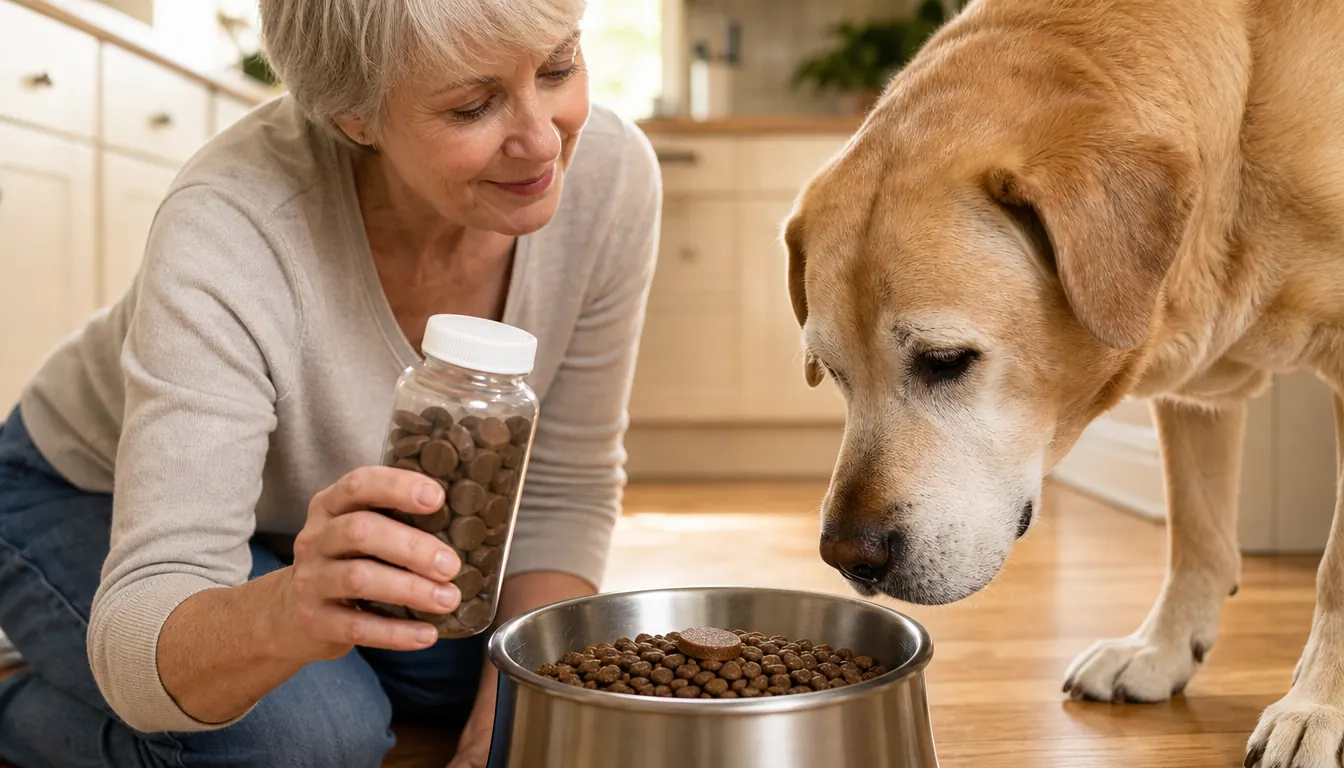
Nutramax Laboratories makes the tablet Dr. Amari named first, with glucosamine hydrochloride, sodium chondroitin sulfate and MSM on the label. Maple takes hers with breakfast and has never once thought of it as medicine.
Amazon Check Today's Price on Amazon →Step 1: Get the diagnosis before you buy a chew
Stiffness in an older dog can come from the hips, the elbows, the spine, the nails, the weight the dog is carrying, or a ligament that has quietly gone. You cannot sort that out by watching from the doorway. I spent my working years as a home health nurse, and the one habit that carried straight over to dogs is this: you do not guess at a joint. Somebody puts hands on it.
Dr. Amari had Maple walk away from her and back down the hallway, lie down, and get up again. She ran her hands over both hips and along the spine, and she watched the left front leg when Maple turned. The answer was arthritis in both hips and the left elbow. I had bought nothing before that appointment and I am glad of it, because I would have bought the wrong thing for the wrong joint. A supplement started on a guess is money spent on a guess.
While you are there, write down a baseline on the back of the receipt. How many seconds it takes your dog to rise from a lying position on carpet. Whether she pauses at the top of the stairs or at the three steps outside the back door. Whether she lags on the way home from the walk or on the way out. Those three notes are what you will hold up against in six weeks, and you will not remember them otherwise.
Step 2: Pick one supplement and read the label before the reviews
The label matters more than the star rating. Turn the container over and look for named ingredients with amounts beside them. The Cosequin label lists glucosamine hydrochloride, sodium chondroitin sulfate and MSM. It is a chewable tablet, which matters for a dog who will take a tablet from your hand and refuse a powder stirred into her food. Nutramax Laboratories has been at this a long while, more than twenty five years according to the company, and the listing describes the product as the number one vet recommended retail joint health supplement brand. I am passing along what the label and the listing say. I did not run a study in my kitchen.
The listing also carries a 4.7 star average across roughly eighty thousand ratings. That tells you the container arrives and dogs eat what is in it. It does not tell you it worked for a twelve year old Lab in Hammonton, New Jersey, which is why the six week note-taking later in this piece matters more than any of those stars.
Buy one thing. This is the sentence I would underline if I were sitting at your kitchen table. The temptation is to order two or three products in the same week and hope the combination does the job. If it does, you have no idea which bottle did it, and you are paying for all three forever. One supplement, one change, six weeks. Then you will know something you can act on.
One note on form. If your dog swallows first and tastes later, that is fine. What matters is that the tablet goes in and stays in. A dog who chews it up and spits it onto the floor is getting nothing, and plenty of dogs are cleverer about this than their owners expect. Watch the floor after the first one.
Step 3: Dose to the label for your dog's weight, at the same hour every day
The package directions give an amount for a dog Maple's size. She is seventy four pounds. I give her that amount and no less. The urge to stretch a container by shaving the dose is strong when you are buying the same thing every month, and it is the wrong urge, because a half dose is not a cheaper version of the same result. It is a different and unmeasured experiment with your dog in it.
The hour matters as much as the amount. Maple gets hers with breakfast, in the kitchen, before I have had my own coffee. She now sits by the counter around seven in the morning and waits, which tells you how she feels about the arrangement. Consistency is not about ritual for its own sake. It is about your memory. A supplement given four days out of seven for three months is not the same thing as one given daily for three months, and you will never untangle which version you ran if the time drifts.
Two cautions, and they belong to your vet, not to me. If your dog takes any prescription medicine, run the supplement past your vet before the first chew, because interactions are real and I am not qualified to rule them out. And if your dog's stomach seems off in the first week, call rather than push through. Maple had no trouble at all. That promises nothing about your dog.
The first change I noticed was not out on a walk. It was Maple standing up in the bedroom without that long pause first.

Step 4: Give it six weeks and write down what you actually see
I started Maple in the first week of March and noticed nothing for a while. Around mid-April, somewhere near the six week mark, I realized I had stopped bracing for the pause. She was rising on the first try more mornings than not. It was not dramatic. Nothing about this is dramatic. She still has stiff days and she still takes the three steps outside the back door one at a time, front paws first.
Judge it on the same three things you wrote down at the vet's office. Seconds to rise. The steps. How she moves after a long rest compared with how she moves twenty minutes into a walk. Add the weather to the note, because a damp week in April reads differently from a dry one in June, and I would have handed the chew credit for a change that was really the barometer dropping.
Do not judge on one bad morning and do not stop on one good week. If the notes at eight weeks show nothing at all, that is an answer too, and it is worth saying out loud to your vet rather than renewing out of habit.
Step 5: Fix the floor, the bed and the car, because a chew cannot do that work
In mid-April I bought Maple a Bedsure SupportMax XL bed and put it on the carpet on my side of the bedroom. It is a rectangular bolster bed with a removable cover and a non-skid bottom, and it replaced a thin flat department store bed she had slept on for years, which went out to the curb. The cover comes off and goes through the wash about every two weeks. The change in how she got up in the morning was easier to see than anything the chew did, and I am not going to pretend otherwise.
In April, on the oak floor in the hall, her back legs splayed out from under her. She was not hurt. It frightened me anyway. In the first week of May I measured her paw at about 2.7 inches against the sizing chart and bought one pack of four DOK TigerToes socks. She wears them indoors during the day and they come off at bedtime. They twist sometimes and I straighten them. Nothing had been tried for traction before that, no rugs, no wax, no boots, so I cannot tell you they beat anything. I can tell you the hall stopped being a place I held my breath.
Then the lifting. In the second week of June I bought a LOOBANI lift sling, a padded sling that goes under the belly with handles, for the rear end only, not a full harness. For a few days before it arrived I used a rolled bath towel under her belly, and that was the only thing that came before it. In the first week of August I added a PetSafe Happy Ride ramp. It weighs 10 pounds, it is 62 inches long and 16 inches wide, and it is rated to 150 pounds. It folds and stands inside against the wall by the back door. I set it on the three back steps for the morning and evening yard trips, and against the rear hatch of the Outback for vet visits. Before the ramp, Walt and I lifted her into the car together. It took Maple about two weeks of treats to walk it without hesitating.
What Else Helps
Weight is the part nobody wants to hear. Maple is seventy four pounds and Dr. Amari would like her closer to seventy, because every pound comes off the hips twice when a dog stands. That conversation belongs to you and your vet, and it will do more for a sore joint than anything on a shelf. Shorter walks more often beat one long one. So does a warm dry place to sleep, and nails kept short, since a long nail quietly changes how the whole foot lands.
And keep the log. Bring it to the next appointment. Eight months of notes, three lines a week, is more useful to a veterinarian than your memory of how last winter went, and it will tell you honestly whether the thing you are buying every month is doing anything. If the answer is no, stop buying it. That is allowed, and no one at the counter will mind.
The one item on this list Maple takes every single day
Eight months on the chewable from Nutramax Laboratories, alongside a better bed, socks for the hall floor, a sling and a ramp. The supplement is the piece I measure in mornings she gets up on the first try.
Amazon Check Today's Price on Amazon →